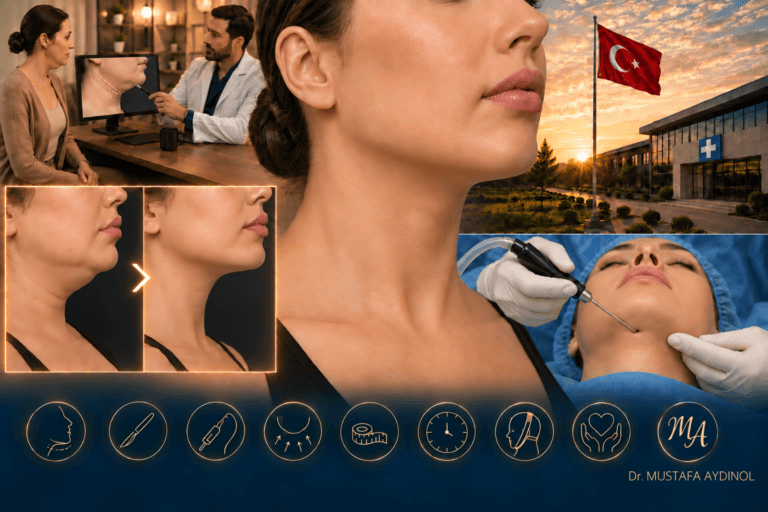


Endolift is a minimally invasive laser treatment that tightens loose skin and reduces small, localised fat deposits without surgery, scalpels or general anaesthesia. Instead of cutting the skin, a hair-thin optical fibre is passed just beneath the surface, where a 1470 nm diode laser warms the deeper layers, melts unwanted fat and stimulates the body to build new collagen.
For people who feel that creams and surface-level devices no longer do enough, but who are not ready for a surgical facelift, Endolift sits in the middle ground. It is more powerful than topical or superficial treatments, yet far less invasive than surgery.
This guide is written by Dr. M. Mustafa AYDINOL, Plastic, Reconstructive and Aesthetic surgeon. It explains, in plain language, what Endolift actually does, who it suits, what results are realistic, and, just as importantly, what it cannot do. Aesthetic medicine is full of overpromises. The goal here is to give you honest, clinically grounded information so you can make a good decision.
Medical note: This article is for general education and is not a substitute for an in-person consultation. Whether Endolift is right for you can only be determined after a physical examination by a qualified doctor.
What is Endolift?
Endolift is a sub-dermal (under-the-skin) laser procedure. A sterile optical fibre, typically just 200 to 600 microns thick (around the width of a human hair), is introduced beneath the skin without any surgical incision. Through this fibre, a diode laser delivers energy directly to the deep dermis and the fat layer just below it.
The laser most commonly used operates at a 1470 nm wavelength, which is strongly absorbed by water and fat. Because the deep layers of the skin and the subcutaneous fat are rich in both, the energy is delivered precisely where it is needed while the surface of the skin (the epidermis) is largely spared. Some systems combine 1470 nm with a 980 nm wavelength for stronger fat-reducing action.
In short, Endolift does three things at once:
- Reduces localised fat in the treated area
- Tightens the skin by causing the tissue to contract
- Stimulates new collagen (a process called neocollagenesis) over the following weeks and months
Because no skin is removed and no stitches are used, there is no surgical scar, and most people return to their normal routine very quickly.
How is it different from a surgical facelift?
A surgical facelift physically lifts and removes excess skin and repositions deeper tissues. It produces the most dramatic, longest-lasting correction, but it involves incisions, a recovery period, and the risks that come with surgery. Endolift does not remove skin. It works by tightening and remodelling the tissue you already have. The trade-off is straightforward: less downtime and lower risk, but more modest results that suit mild to moderate laxity rather than severe sagging.
How does Endolift work? (Step by step)
- Consultation and assessment. The doctor examines the area, assesses how much laxity and fat are present, and confirms whether Endolift is appropriate, or whether another treatment (or surgery) would serve you better.
- Marking and local anaesthetic. The treatment zones are mapped. Comfort is managed with a topical anaesthetic cream and/or local anaesthetic, and cooling is also used. General anaesthesia is not required.
- Fibre insertion. The micro-thin laser fibre is passed beneath the skin through a tiny entry point that does not require stitches.
- Laser delivery. As the fibre is moved through the tissue, controlled laser energy gently heats the deep dermis and fat. This causes immediate tissue contraction and triggers the collagen-building response.
- Same-day return to life. The session typically takes a short time per area. Most people walk out and resume daily activities quickly, sometimes the very next day.
When an area has both excess fat and sagging, treatment may be staged: the fat is reduced first, then the skin tightening is addressed. When there is sagging without significant fat, the fat-reduction step is simply skipped.
Which areas can Endolift treat?
Endolift is used on both the face and the body, wherever there is mild-to-moderate skin laxity or a small, stubborn fat pocket. The most commonly requested areas include the following.
Face and neck
- Jowls and the lower face, one of the most popular uses, for softening the sagging along the jaw
- Jawline definition, sharpening a blurred or lost jaw contour
- Double chin (submental fat), reducing fullness under the chin
- Neck laxity
- Eye area and under-eye bags, using lower energy in this delicate region
- Nasolabial folds and general lower-face rejuvenation
Body
- Arms (the upper-arm “bat wing” area)
- Inner and outer thighs
- Abdomen and the “tummy” area
- Knees
Because the laser fibre is so fine and the energy is adjustable, treatment can be tailored to delicate facial zones and larger body areas alike. The right energy setting matters. Research suggests there is an optimal energy window: too little does too little, while excessive energy risks thermal damage to the tissue. This is precisely why operator experience matters more than the machine itself.
What results can you expect? (And how soon)
Honesty is important here, because expectations are where patients are most often let down.
- Immediately: some tightening is visible right away due to tissue contraction, though this is partly masked by mild swelling.
- Weeks 2 to 6: swelling settles and the early tightening becomes clearer.
- Months 1 to 3 and beyond: the main result develops gradually as new collagen forms. Skin continues to firm and refine over this period.
Most people achieve their goal in a single session, though some areas or more advanced laxity may benefit from one to three sessions. Many patients also choose an occasional maintenance session to preserve results over time.
How long does Endolift last?
The collagen your body builds is real, lasting tissue, so results are durable. They are commonly reported to last around two to three years or more. However, no treatment stops the clock. Your skin continues to age naturally, and lifestyle factors such as sun exposure, smoking and weight change all influence how long results hold.
Does Endolift really work?
For the right candidate (mild to moderate laxity, realistic goals) it can produce a genuine, visible improvement with very little downtime. It is worth being transparent that, while published case reports and reviews are encouraging, the aesthetic literature still calls for large-scale randomised controlled trials to fully establish long-term efficacy. A good doctor will tell you this rather than promise a miracle.
Recovery and downtime
One of Endolift’s biggest attractions is how little recovery it requires compared with surgery. A typical experience looks like this:
- First few days: some redness, swelling and possibly mild bruising in the treated area. This is normal and usually settles within a few days.
- Sensation: mild tenderness or a “worked-out” feeling is common, while significant pain is unusual.
- Back to routine: many people return to work and social life within a day or so, which is why it is sometimes described as a “lunchtime” type of procedure. Even so, it should never be treated casually.
Your doctor will give you specific aftercare instructions. These may include avoiding intense heat, sun and strenuous exercise for a short period, and sometimes wearing a compression garment for body areas.
Is Endolift safe? Side effects and risks
When performed by a qualified, experienced practitioner, Endolift has a favourable safety profile. Because it avoids open surgery, it sidesteps several risks associated with a surgical facelift and even some injectable treatments, including surgical scarring, muscle atrophy, brow droop and facial-nerve injury.
That does not mean it is risk-free. Possible side effects include:
- Swelling, redness and bruising (common, temporary)
- Tenderness in the treated area
- Mild burns or skin irregularities if energy is set incorrectly, an operator-dependent risk
- Temporary numbness or firmness as tissue heals
- Rarely, infection or pigment changes
Most reported side effects are mild and self-limiting. The single most important factor in staying on the safe side is who holds the laser. The energy settings, fibre depth and technique must be matched to your anatomy. This is a medical procedure and should be performed by a doctor with genuine training in laser and aesthetic medicine, not delegated to non-medical staff.
What about “bad reviews”?
Negative experiences with Endolift almost always trace back to one of three things: an unsuitable candidate (too much sagging for a non-surgical option), unrealistic expectations (expecting surgical results), or poor technique (wrong energy, wrong depth, inexperienced hands). A careful consultation that turns away the wrong candidates is, paradoxically, the best predictor of good reviews.
Who is a good candidate for Endolift?
Endolift may suit you if you:
- Have mild to moderate skin laxity (early jowls, a softening jawline, mild neck or body laxity)
- Have a small, localised fat pocket you would like reduced
- Want meaningful improvement without surgery or long downtime
- Have realistic expectations about gradual, natural-looking change
Endolift is probably not the right choice if you:
- Have severe sagging or a large amount of excess skin (a surgical lift will serve you better)
- Are pregnant or breastfeeding
- Have an active skin infection in the area
- Expect a dramatic, surgical-grade transformation in one go
The honest answer to “is this right for me?” only comes from an examination. A responsible clinic will sometimes recommend against Endolift, and that is a sign of trustworthy advice, not a lost sale.
How much does Endolift cost?
Endolift pricing depends on several factors, so a single fixed number is misleading. The main variables are:
- The area treated and its size (a single facial zone versus multiple body areas)
- The number of sessions needed for your goal
- The energy and extent of treatment required
- The clinic, the technology, and the experience of the doctor performing it
Because of this, the only accurate price is the one quoted after a personal assessment of your face or body. Be cautious of clinics advertising suspiciously low flat rates. With a medical laser procedure, the experience of the hands guiding the fibre is not where you want to economise.
Endolift in Istanbul with Dr Mustafa Aydınol
If you are researching Endolift and considering treatment in Istanbul, it is worth understanding who will be performing it.
Endolift is, at its core, a medical procedure that lives or dies by technique: the depth of the fibre, the energy delivered, and the judgement of when not to treat. That is why it should be in the hands of a qualified surgeon, not a technician.
Dr Mustafa Aydınol is a Plastic, Reconstructive and Aesthetic Surgeon based in Istanbul, with extensive experience treating an international patient base, including patients travelling from Germany, Italy, the UK and France. International patients choose Istanbul not only for value, but for access to experienced surgeons working in a city with deep expertise in aesthetic medicine.
What this means for you as a patient:
- A surgeon-led consultation that honestly assesses whether Endolift is the right treatment, or whether a different procedure would serve you better
- A treatment plan tailored to your anatomy, with energy and technique matched to the area
- Clear aftercare and follow-up, with experience supporting international patients through the process
- Realistic, transparent guidance on results, timelines and cost
If you are exploring “endolift near me” from abroad and would like a professional opinion on whether you are a good candidate, you can request a consultation. Share your concern and, where helpful, photographs, and you will receive an honest assessment rather than a sales pitch.
Frequently asked questions
Is Endolift painful?
Most patients report only mild discomfort. The area is numbed with topical and/or local anaesthetic, and cooling is used. A mild tender or “worked-out” sensation afterwards is normal.
How long does an Endolift session take?
It varies by area, but a single zone is generally treated relatively quickly, often within a short appointment. Multiple or larger areas take longer.
When will I see results?
Some tightening is visible immediately, but the main result builds gradually over one to three months as new collagen forms.
How long do Endolift results last?
Results are durable, commonly reported to last around two to three years or more, but natural ageing continues, so maintenance sessions can help preserve the effect.
Is there much downtime?
Very little. Expect some swelling, redness and possibly mild bruising for a few days. Many people return to normal activities within a day or so.
Can Endolift replace a facelift?
No. Endolift is excellent for mild to moderate laxity and small fat pockets. Severe sagging is better corrected with a surgical lift. A consultation will tell you which category you fall into.
Is Endolift safe?
It has a favourable safety profile in experienced hands and avoids many surgical risks. Side effects are usually mild and temporary. Choosing a qualified, experienced doctor is the most important safety factor.
Which areas can be treated?
Common areas include the jowls, jawline, double chin, neck, under-eyes, arms, thighs, abdomen and knees.
Related Posts
 Liposuction in Turkey: A Plastic Surgeon’s Guide to VASER, Lipo 360 and HD Liposuction
 Loose Skin After Weight Loss: A Plastic Surgeon’s Guide to Surgery After Weight-Loss Medication
 Nano Fat Grafting: Enhancing Results in Plastic Surgery
 Ozempic Face: Why Rapid Weight Loss Ages the Face and How Fat Grafting Restores It