


 Dr. Mustafa Aydınol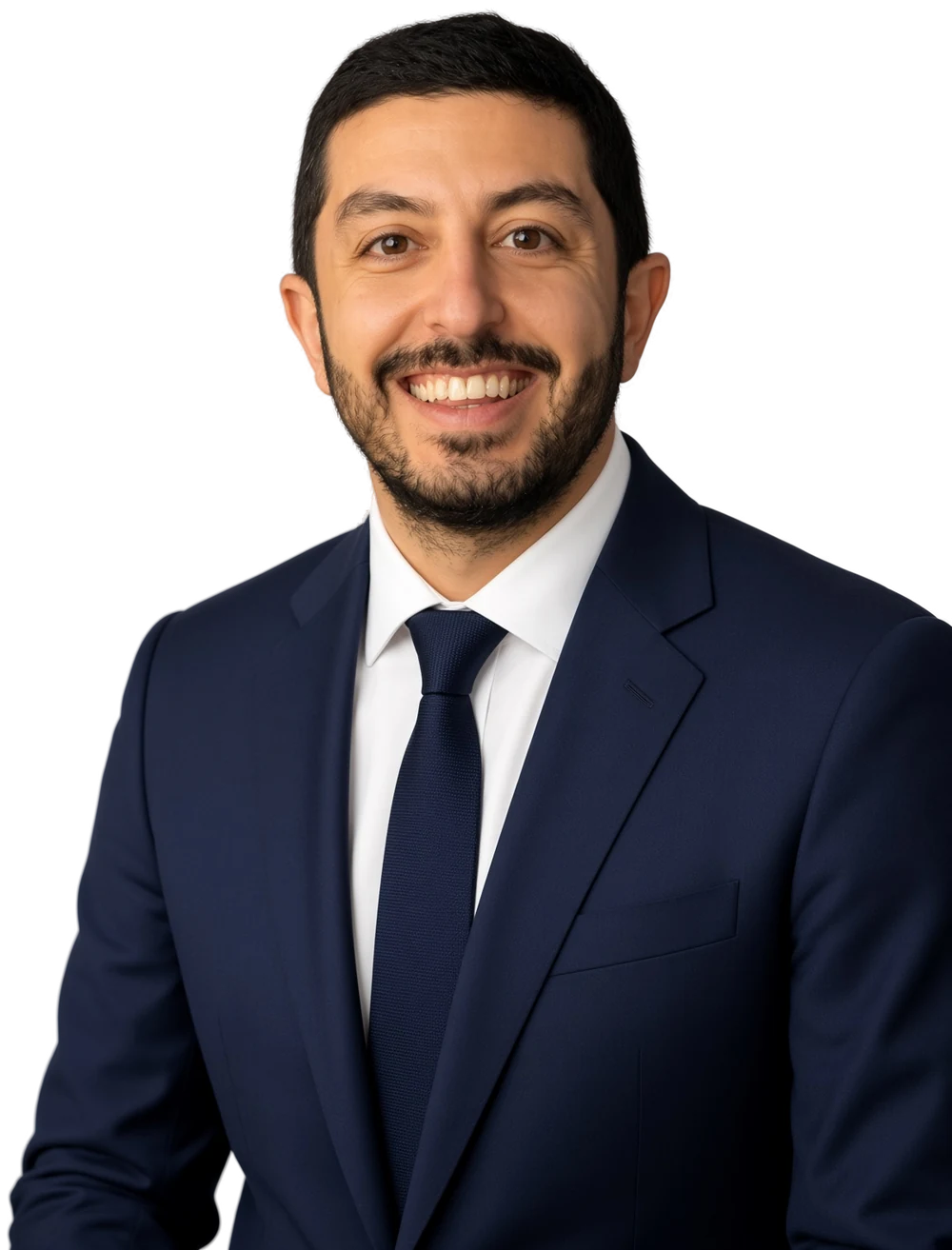
The Breast Surgery Guide
Augmentation, lift and reduction. What I explain to every patient before breast surgery in Istanbul: which operation fits which breast, how implants are chosen, and what your recovery really looks like.
- ISAPS member
- Turkish Society of Plastic Reconstructive and Aesthetic Surgeons
- Health Tourism Authorization, Turkish Ministry of Health
In this guide
- What breast surgery can do, and what it cannot
- Implants: size, type and placement
- Which operation fits your breasts
- Lift and reduction: the scar follows the breast
- Results from my practice
- Are you a good candidate?
- The operation
- Your days in Istanbul
- After you fly home
- Risks and honest limits
- How to read before and after photos
- Questions to ask any surgeon
- Cost and how to get a quote
- About Dr. Aydınol and your next step
Before you start
Breast surgery is not one operation. An augmentation, a lift, a lift with implants and a reduction treat different problems, leave different scars and need different recoveries. Choosing the right one for your breasts matters more than anything else in this guide.
The question every patient asks first is what size. The question I answer first is what fits. Your frame, your tissue and where your nipple sits decide the plan, not a number from social media.
Read this guide at your own pace. When you are ready, send me a few photographs and I will tell you honestly which operation your breasts need, and whether you need one at all.
What breast surgery can do, and what it cannot
Breast surgery changes three things: volume, position and size. Most disappointment comes from treating the wrong one, such as an implant for a breast that has dropped, or a lift for a breast that is simply small.
I assess every breast in three ways
Volume
Is there too little, or too much? An implant, fat or both add volume; a reduction removes it and brings the breast into proportion with your body.
Position
Where the nipple sits relative to the fold under the breast. If it has dropped, the breast needs a lift, with or without an implant.
Tissue
Skin elasticity, tissue thickness and the shape of the chest wall. They decide the implant, its placement and the length of the scar.
What breast surgery will not do
- An implant does not lift a breast that has dropped significantly. Often a lift is the honest recommendation, and I will tell you so directly.
- A lift does not add volume. It restores position and shape, and the breast becomes slightly smaller because skin is removed.
- It does not stop time. Pregnancy, weight change and age will still change your breasts, and implants are not lifetime devices.
Not sure you want an implant, or a large one?
Your own fat, taken by liposuction, adds a subtle half to one and a half cup sizes. Part of it resorbs, so one or two sessions may be planned.
A smaller implant with fat grafted over it: a softer edge in slim patients with thin tissue. It is part of my published clinical work.
The honest boundary: fat cannot lift a breast that has dropped, and it cannot make a large change in size. That takes an implant, a lift or both. Breast surgery options
Implants: size, type and placement
Implant selection is measurement, not shopping. I measure the base width of your breast, the thickness of your tissue, your skin elasticity, the shape of your chest wall and the position of the fold, then we try sizers together.
Type and profile
I use cohesive silicone gel implants from established manufacturers with international safety track records. Round implants suit most goals; the profile, how far the implant projects, is where most of the fine tuning happens.
Placement and incision
Most of my patients get a dual plane placement, partly under the muscle, which is particularly forgiving in slim patients with thin tissue. Above the muscle can be right when the tissue cover is generous. I prefer an incision in the fold under the breast, where the scar hides.
Are implants for life?
No. Many patients keep the same implants for fifteen years or longer, and there is no fixed date to replace them, but plan on the assumption that an exchange may be needed at some point. If your implants are more than six years old and have never been scanned, have an ultrasound.
A cubic centimetre number copied from social media is not a plan. Copying another woman’s numbers is like wearing her prescription glasses: the product is identical, the result is not.
Which operation fits your breasts
Breast augmentation
For small breasts relative to your frame, volume lost after pregnancy or weight loss, or asymmetry, with the nipple still at or above the fold.
Composite augmentation
A smaller implant with structural fat grafting, for slim patients with thin tissue, mild asymmetry or after weight loss. It needs enough fat to take.
Fat transfer
A subtle change of half to one and a half cup sizes with your own fat, for patients who want no implant and have fat to spare.
Breast lift
For breasts that have dropped. The nipple is lifted and the tissue reshaped; fullness in the upper breast can come from your own tissue or from fat.
Lift with implants
For a breast that has dropped and lost volume. More demanding: the lift tightens the skin while the implant stretches it. Two stages when sagging is severe and the implant large.
Breast reduction
For heavy breasts that cause neck, shoulder and back pain, strap grooves or rashes. Typically one to three cup sizes smaller, with a lift built in.
Often planned in the same operation
- A tummy tuck and liposuction, as a mommy makeover
- Liposuction of the side of the chest and the area towards the armpit
- Fat transfer to the upper breast, or to the buttocks
- Implant removal with a lift, for patients who want their implants out
At most three major lifts go into one session, and a breast lift or reduction counts as one. Combinations are planned in advance, as one operation and one recovery.
Lift and reduction: the scar follows the breast
Both operations lift the nipple and reshape the breast. How far the breast has dropped, and how much loose skin there is, decides the scar. I choose the shortest scar that will actually hold the result.
Around the areola
Only for mild sagging with good skin. It raises the nipple one to two centimetres and can make the areola smaller. Used for more sagging, it flattens the breast and widens the scar.
Vertical, or lollipop
The workhorse for moderate sagging and for small to moderate reductions. It narrows the base and gives a more projected shape. The scar looks alarming at first and settles well over a year.
Anchor, or inverted-T
For severe sagging, very loose skin after weight loss and large reductions. It adds a scar in the fold under the breast, which the breast itself hides when you stand.
How I protect sensation and breastfeeding
- The nipple stays attached to a pedicle, a bridge of tissue that carries its blood and nerve supply. It is moved, not cut free.
- In most reductions I use a superomedial pedicle; in very large breasts an inferior pedicle is an alternative.
- Only in extreme cases is the nipple removed and grafted back. It is rare, it means sensation and breastfeeding are lost, and I tell you in advance.
- The tissue removed in a reduction is weighed and sent for routine pathology.
When is the right time?
When your weight has been stable, usually for four to six months, and when you are not planning a pregnancy soon. If you are, it is usually better to wait until afterwards. After major weight loss, most patients need the anchor pattern.
Results from my practice
These are my own patients, photographed before and after surgery.
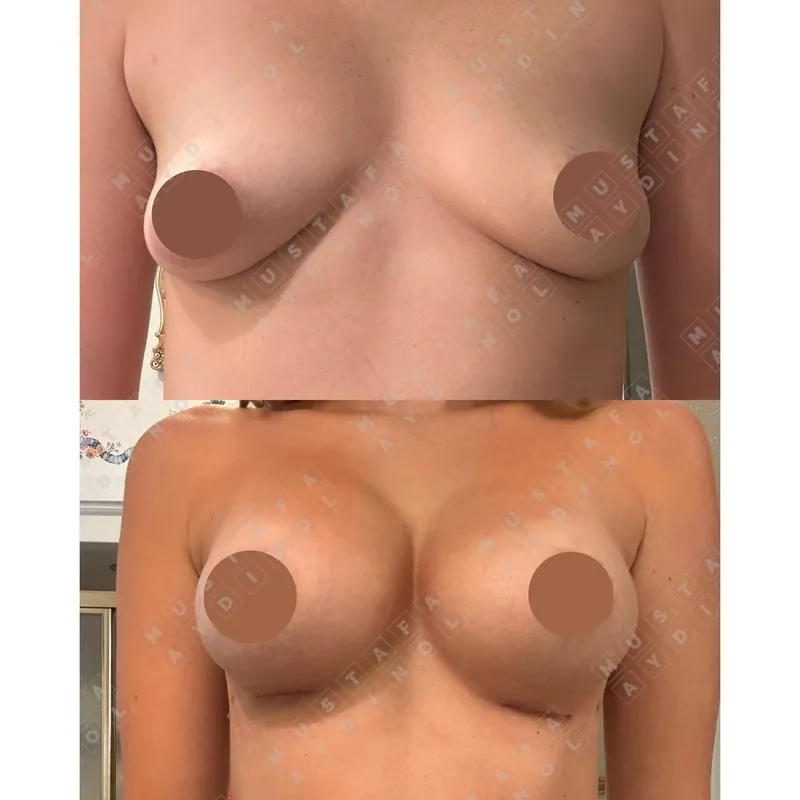 Augmentation
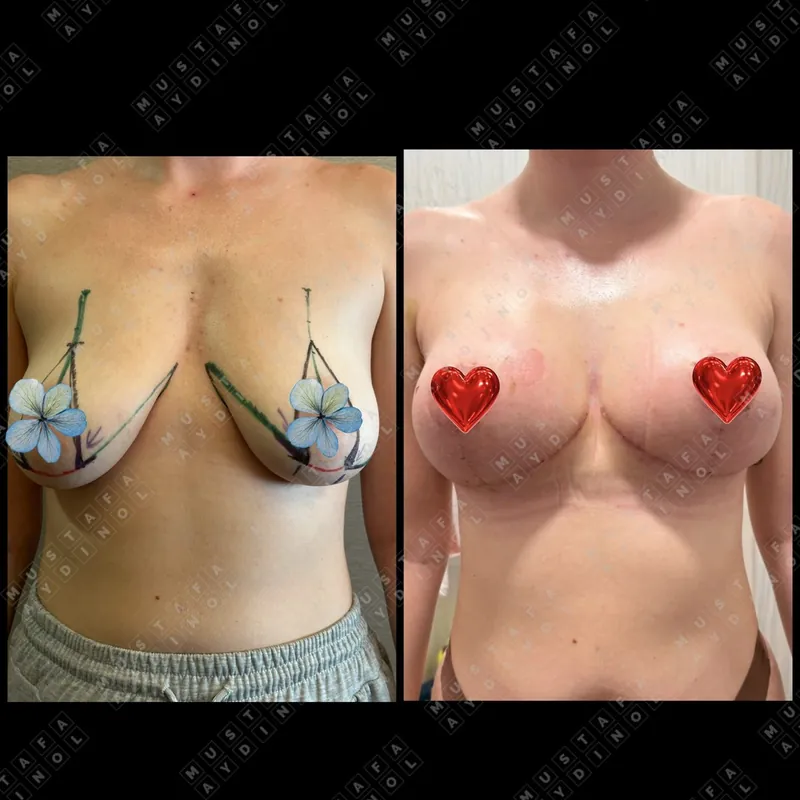 Lift with implants
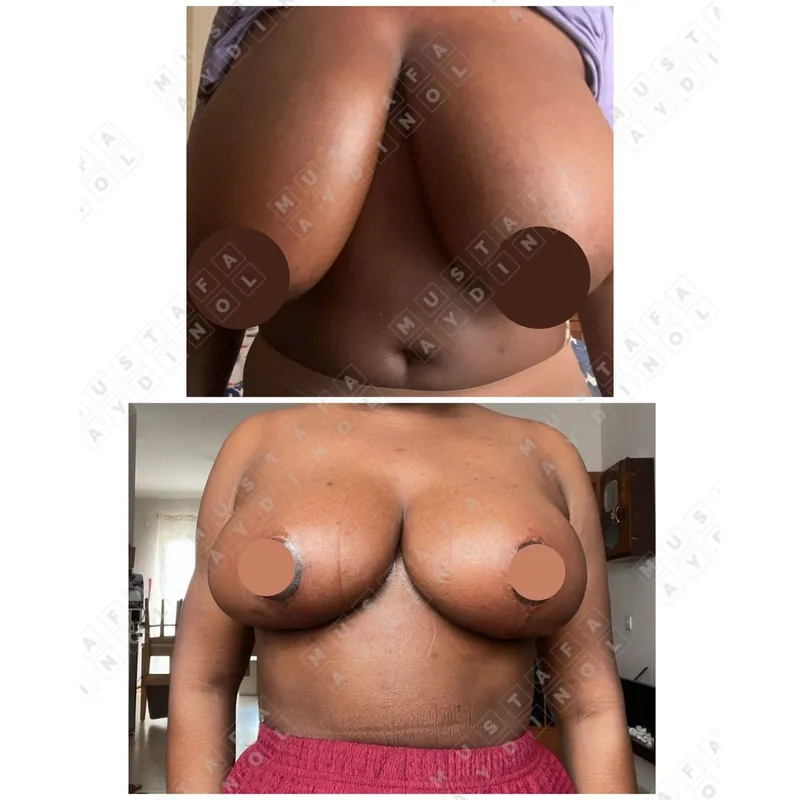 Reduction and lift
Three different operations
A breast augmentation with implants, a breast lift with implants, and a breast reduction with a lift. In each photo, before is on top or on the left, after on the bottom or on the right.
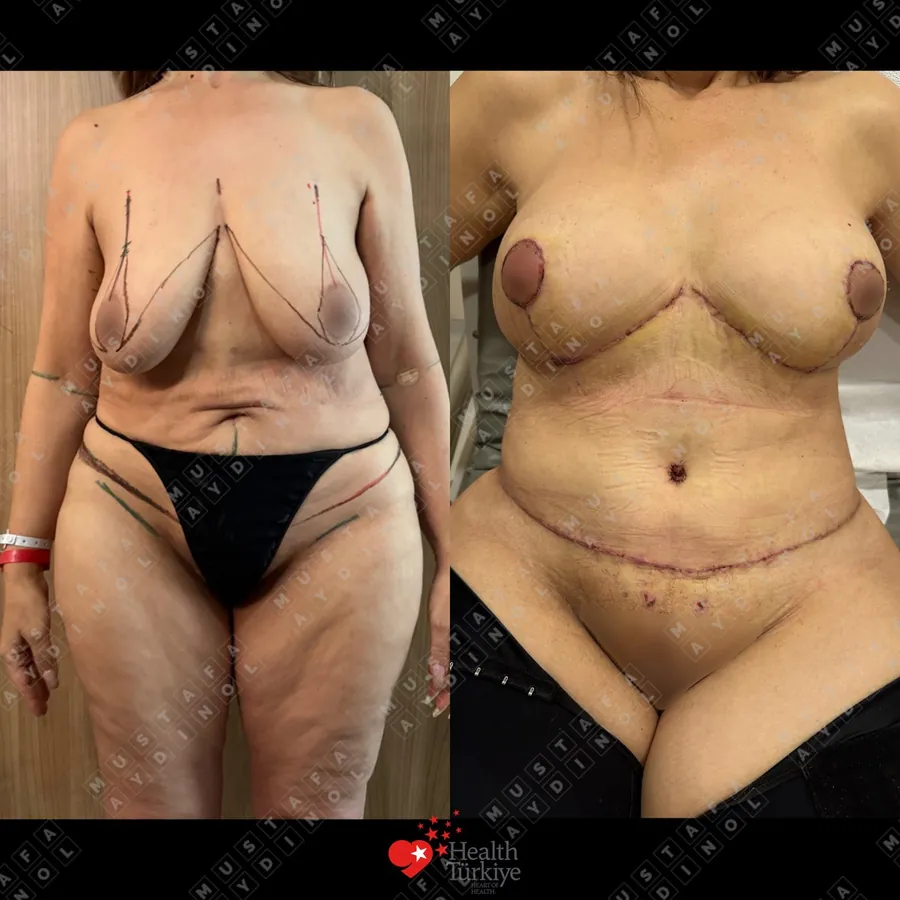
Breast lift without implants
With a tummy tuck, 360 liposuction and a BBL, age 60. Before (left) and one week after (right).
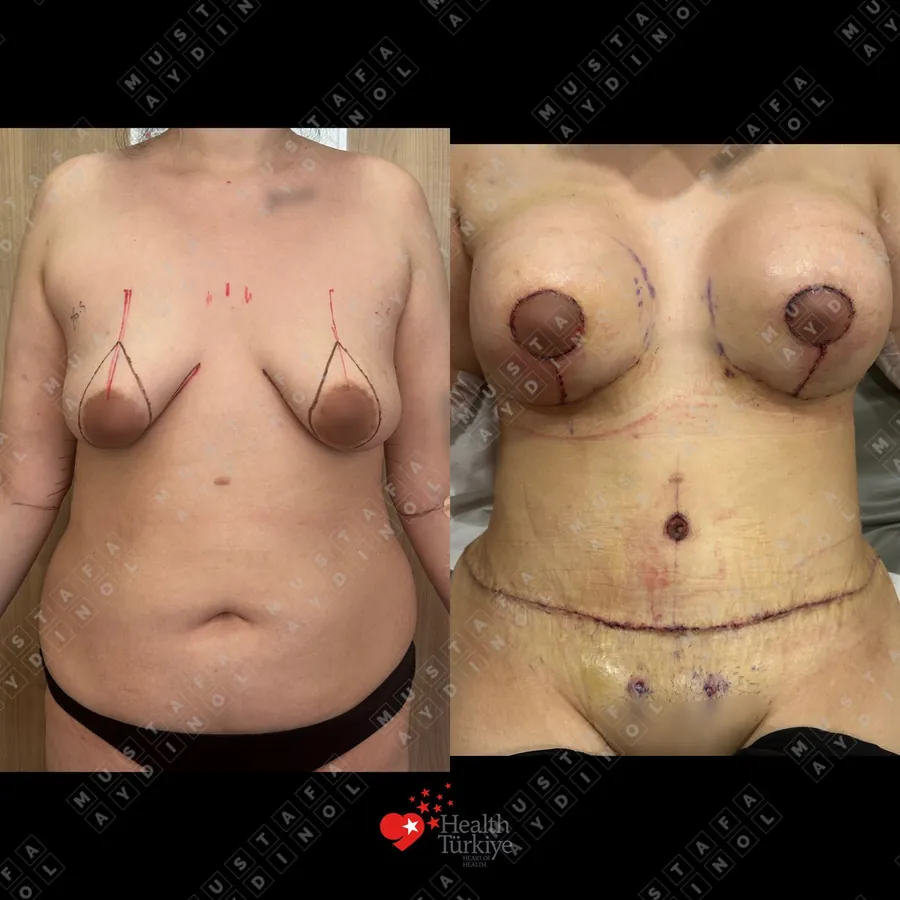
Breast lift with implants after 30 kg weight loss
Part of a mommy makeover with a tummy tuck, liposuction and a BBL, age 28. Before (left) and one week after (right).
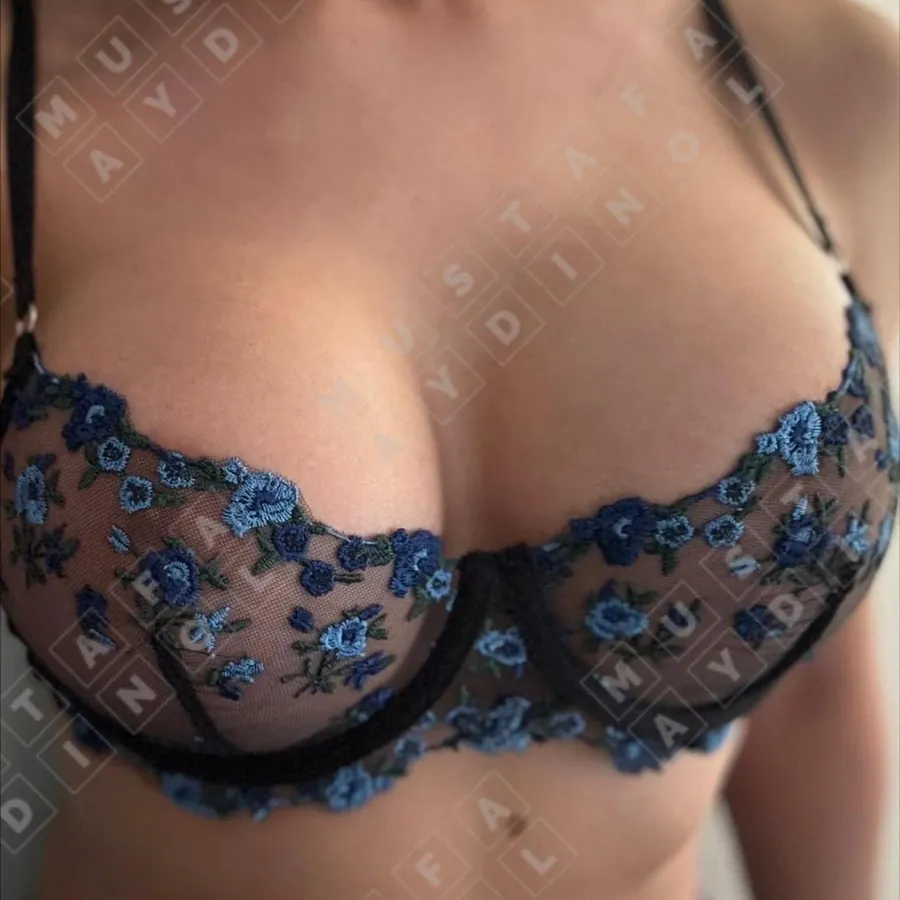
Breast augmentation
After surgery. Some patients give permission for after photos only.
Capsular contracture after a breast lift with implants: the deformed implants were replaced and the contracture treated.
More results: Before and after gallery
Are you a good candidate?
The right operation depends on your breast, not on a size. The best candidates are in good general health, at a stable weight, and clear about what bothers them.
Most of my breast patients fall into three groups
Too little volume
Small breasts for the frame, or volume lost after pregnancy, breastfeeding or weight loss, with the nipple still in place. An augmentation, with an implant, fat or both.
Sagging
After pregnancy, breastfeeding or weight loss, or natural sagging. A lift, with or without an implant; after major weight loss, usually the anchor pattern.
Too heavy
Neck, shoulder and back pain, strap grooves, rashes under the breast, limits on sport. A reduction, which is as much about relief as about shape.
When I will say no, or not yet
- Your breast has dropped and you want an implant alone. Often it is not enough, and I will tell you so directly.
- Your weight is still changing, including on weight-loss medication. I usually want it stable for four to six months.
- You are planning a pregnancy soon. It is usually better to wait until afterwards.
- You ask for a size your tissue cannot carry, or yet another increase. At some point my job is to say no.
The operation
I plan a reduction by proportion, not by a promised cup size. The tissue itself sets the limit, so I do not guarantee a cup size.
Stitches, scars and dressings
The skin is closed in layers with absorbable stitches, so there are no stitches to remove. After an augmentation the scar sits in the fold under the breast; after a lift or reduction it follows the pattern your breast needs.
Your final dressing is done at the check-up before you fly, and you take spare dressings home. Drains are never left for you to manage at home.
Your days in Istanbul
Plan five to seven days in Istanbul.
- Day 0
Surgery
Your operation under general anaesthesia. You walk the same evening.
- Day 1
One night in hospital
A night of close observation, then you move to your hotel in your surgical bra, with daily contact from my team.
- Days 2 to 3
Hotel
Drains usually come out on day two or three, based on how much fluid they collect in 24 hours. Short walks every day, and keep the dressings dry.
- Days 5 to 7
Final check
Your final examination and dressing, the day before your flight. Most patients fly home between day five and seven.
After you fly home
- Around 1 to 2 weeks
After an augmentation, desk work from around day seven and driving from day ten; after a lift or reduction, day ten and day twelve. Your first shower around day ten, when you also change your own dressing.
- Around 3 to 4 weeks
Scar care starts, with silicone gel or sheets and sun protection. From around week three a soft wireless sports bra, and sleeping on your side if comfortable. Light cardio for the lower body, and a bath, pool or the sea, from around week four.
- 6 weeks
Wear your support bra day and night until around week six. Then support can ease off, and chest exercises, upper body training and heavy lifting can start.
- 3 months to a year
Implants drop and soften into their final position over about three months; judge the result at six. After a lift or reduction the shape settles by about four months, and the scars keep maturing for a year or more.
Normal in the early weeks
- Tightness and swelling, most of it in the first two weeks
- Implants that sit high and feel firm at first
- Changes in nipple sensation, which usually settle
- Scars that look red and raised for the first months
Contact my team straight away if you notice
- Fever above 38°C
- One breast suddenly more swollen, red or painful
- Discharge from an incision
- A painful calf or shortness of breath
Risks and honest limits
Any surgeon who presents breast surgery as risk free is not informing you. Not smoking is the single most important thing you can do to protect your healing: I ask you to stop four weeks before surgery.
Capsular contracture
Scar tissue around an implant that tightens and hardens it. Good tissue cover and consistent support while the capsule forms reduce it; when it happens, it is treated with a revision.
Wound healing
After a lift or reduction, most likely where the scars meet under the breast. Seroma, haematoma, infection and, rarely, partial loss of the nipple are the other risks.
Sensation and breastfeeding
Nipple sensation often changes early on and usually returns, but it can be reduced. Breastfeeding is usually possible, but no surgeon can guarantee it.
Implant and shape
Malposition, rippling in thin tissue and asymmetry. BIA-ALCL is rare and associated mainly with certain textured implants, which is why the implant and its maker matter.
Two honest limits
Implants are not lifetime devices, and a lift or reduction does not stop time. Pregnancy, weight change and age still change the breast; some patients need a revision a decade or more later.
Scars are permanent. They fade over one to two years but do not disappear, and how they look depends on your skin as much as on my technique.
How to read before and after photos
Breasts are easy to flatter in a photo: a push-up bra, raised arms, a turn of the shoulders. A fair comparison shows you the whole picture.
What to look for
- The same posture, distance and light in both photos, with the arms down.
- Where the nipple sits on the breast, not only how large the breast is.
- The scars: where they are and how long, not only the shape.
- Time stamps. Implants sit high and firm for weeks, and scars stay red for months. Ask to see six and twelve months.
I apply the same rule to my own patients. The shape you see at day five is not the shape you will live with; the result you will live with is the one at month six.
Questions to ask any surgeon
The surgeon matters more than the technique, and the structure around the surgery matters as much as the surgery itself.
- Are you certified in plastic, reconstructive and aesthetic surgery, and which societies are you a member of?
- Which operation do you recommend for me, and why not the alternatives?
- How did you choose the implant size, type and placement for my body?
- Which manufacturer makes the implant, and what warranty comes with it?
- Where exactly will my scars be, and why that pattern?
- How do you protect nipple sensation and the possibility of breastfeeding?
- Who checks me in Istanbul after surgery, and who do I contact once I am home?
- What exactly is included in the price?
Red flags
- A price before anyone has seen your photographs
- An implant size chosen from a photo or a cc number
- An implant alone for a breast that has clearly dropped
- A quote that does not name the implant maker
Cost and how to get a quote
I do not publish a single price, because there is no single breast operation. Surgery in Istanbul costs substantially less than in the United Kingdom, Germany or the wider EU because local operating costs are lower, not because anything is left out in theatre.
What shapes your quote
- The operation: augmentation, lift, lift with implants or reduction
- The implants, with the manufacturer and warranty named
- Added fat transfer or liposuction
- Whether it is combined with other surgery, and the hospital stay
How to get your quote
Send your photographs
Front and side views, standing relaxed with your arms down, with your height, weight and bra size.
Video call
We talk through what you want, what your body needs, and your questions.
Written quote
Your plan and your quote in writing, including the hospital, anaesthesia, the implants, pathology after a reduction, follow-up in Istanbul and post-operative contact.
About Dr. Aydınol
I completed my specialist training in plastic, reconstructive and aesthetic surgery at Dicle University (2012 to 2017) and have run my own practice in Istanbul since 2020. My work covers facial rejuvenation, rhinoplasty, breast surgery and body contouring, always with the same rule: the right procedure at the right time, or an honest no.
Patients from Germany, Italy, the United Kingdom, the Middle East and many other countries travel to Istanbul for surgery with me. My team and I plan the whole trip around the operation.
- 10,000+ procedures
- ISAPS member
- Turkish Society of Plastic Reconstructive and Aesthetic Surgeons
- Rhinoplasty Society of Europe
- Health Tourism Authorization, Turkish Ministry of Health
Your next step
Send a few photographs on WhatsApp. Tell me what bothers you most, and I will tell you honestly what I would recommend.
- +90 544 772 07 72
- info@mustafaaydinol.com
- Clinic
- Yeşilçimen Sokak No:12, Polat Tower Residence K:2 D:20, Fulya, Şişli, Istanbul
Keep a copy
Download the PDF to read offline or share it with someone who is coming with you.
Plan your trip
- Recovery plannerWhen you can fly home, work and exercise
- Surgery readiness checkWhat to settle before surgery
- When should I stopWhich medicines to stop, and when
- Combination plannerWhat can be done in one session
This guide is general information and does not replace a personal medical consultation. Your plan, the operation and your recovery depend on your own examination.