

A new generation of weight loss medications has helped millions of people lose significant amounts of weight, often very quickly. The health benefits are real and well-documented. But for many patients, a second, less expected challenge appears as the weight comes off: loose, sagging skin that diet, exercise and creams simply cannot fix.
This guide is written by a practising plastic, reconstructive and aesthetic surgeon. It explains, briefly and factually, the health benefits of significant weight loss; why skin often does not “snap back” after rapid loss; and the surgical procedures that genuinely restore body and facial contour once your weight has stabilised. The aim is to give you honest, clinically grounded information so you can decide on the right next step.
Medical note: This article is for general education and does not replace personal medical advice. GLP-1 medications are prescription drugs that should only be used under the supervision of a qualified physician. Surgical decisions require an in-person examination by a plastic surgeon.
The new weight loss landscape: Ozempic, Mounjaro and GLP-1 drugs
Over the past few years, a class of medications known as GLP-1 receptor agonists has dramatically changed the conversation around weight loss. Drugs such as semaglutide (marketed as Ozempic and Wegovy) and tirzepatide (marketed as Mounjaro and Zepbound) were initially developed for type 2 diabetes. It was soon observed that they also produced substantial, sustained weight loss in many patients.
These medications work by mimicking hormones that regulate appetite and blood sugar. The practical effect is that patients feel fuller sooner, eat less, and lose weight at a rate that previously was only achievable through bariatric surgery.
The health benefits of significant weight loss
For patients who carry excess weight, particularly those with related health conditions, losing a meaningful percentage of body weight is one of the most powerful health interventions in modern medicine. Documented benefits include:
- Lower cardiovascular risk: reduced blood pressure, improved cholesterol, and a measurably lower risk of heart attack and stroke
- Better blood sugar control: improvement or even reversal of type 2 diabetes in many patients
- Reduced joint pain: particularly in the knees and hips, where excess weight accelerates wear
- Improved sleep: including a meaningful effect on obstructive sleep apnoea
- Better fertility outcomes in some patients with weight-related infertility
- Improved mental wellbeing and quality of life
These are serious medical gains. Whether GLP-1 medications are appropriate for any given person is a decision that belongs with a qualified physician who can weigh the benefits against side effects, contraindications and personal medical history. That conversation is outside the scope of a plastic surgeon. What is squarely within the plastic surgeon’s domain is the next part of the story: what happens to the body’s outer envelope when the weight comes off.
Why skin sags after rapid weight loss
Skin is not a passive wrapper. It is a living, layered tissue with two protein systems that determine how well it holds its shape: collagen, which gives strength, and elastin, which gives the ability to recoil after stretch. When the body carries excess weight for years, the skin stretches to accommodate it. Some of that stretch is recoverable. A lot of it is not.
When weight is lost slowly over a long period, the skin has time to remodel and retract somewhat. When weight is lost rapidly, as is often the case with GLP-1 medications or bariatric surgery, the skin simply cannot keep pace. The fat underneath shrinks; the envelope around it does not. The result is loose, sagging skin that hangs from the abdomen, arms, thighs, breasts, neck and face.
How much loose skin a particular patient develops depends on several factors:
- How much weight was lost. The more dramatic the loss, the more skin is left over.
- How quickly it was lost. Faster loss generally means worse skin retraction.
- Age. Younger skin has more elastic reserve. After roughly the mid-thirties, the ability of skin to recoil declines steadily.
- Genetics. Some people inherit better skin quality than others.
- Previous stretching. Prior pregnancies, prior weight cycling, or stretch marks all signal that the elastic network has already been damaged.
- Sun damage and smoking. Both degrade collagen and elastin and worsen the outcome.
It is important to be honest about one thing. Once the elastic fibres in the deeper skin layers have been permanently overstretched, no cream, no laser, no diet and no amount of exercise will fully reverse it. Mild laxity in younger patients can improve over time, and non-surgical treatments can help at the margins. But for the loose folds and “aprons” of skin that follow major weight loss, surgical removal is the only reliable solution.
Where the loose skin tends to appear
The most common areas, in roughly the order patients raise them in consultation, are:
- Abdomen: a hanging “apron” of skin, often with stretch marks, that no amount of core exercise can flatten
- Upper arms: the area between the shoulder and elbow that swings when the arm is raised
- Inner thighs: loose skin that rubs together, sometimes causing chafing and skin breakdown
- Breasts: deflation and sagging, often more pronounced than before the weight gain
- Buttocks and outer thighs: a flattened, deflated shape
- Face and neck: hollowing of the cheeks and temples, loose skin along the jawline and under the chin (what the media has come to call “Ozempic face”)
When is the right time to think about surgery?
Timing matters more than many patients realise. The standard guidance, and the one I follow in my own practice, is that you should be at a stable weight for at least six to twelve months before scheduling body contouring surgery. The reason is straightforward: if you continue to lose weight after surgery, new laxity develops and the result you paid for is undermined. If you regain weight, the closure may be stretched and scars widened.
Beyond weight stability, a good candidate is:
- In good general health, with any chronic conditions well-controlled
- Nutritionally optimised, including adequate protein and any vitamins your physician recommends (this is especially important after rapid weight loss, where deficiencies are common)
- A non-smoker, or willing to stop well before surgery and during recovery
- Realistic about what surgery can and cannot achieve, and about the scars involved
The last point deserves emphasis. Body contouring surgery after major weight loss does notleave invisible scars. It trades loose, hanging skin for a tighter contour with a planned, well-placed scar. For most patients who reach the point of seeking this surgery, that trade is worth making. But it is a trade, and a responsible surgeon will make sure you understand it before, not after, the operation.
Body contouring procedures after weight loss
Below is a plain-language overview of the main procedures used to remove excess skin and restore body shape after significant weight loss. Most patients need a combination, often staged over more than one operation rather than carried out all at once. Your surgical plan is built around your anatomy, your goals, and what is safe to do in a single setting.
Tummy tuck (abdominoplasty)
The most commonly requested procedure after weight loss. The surgeon removes the excess skin and fat from the lower abdomen and, in most cases, repairs the abdominal muscles, which are often separated by previous weight gain or pregnancy. The result is a flatter, firmer abdomen with a horizontal scar low enough to be hidden by underwear. For patients with loose skin extending around the flanks and back, an extended tummy tuck or fleur-de-lis abdominoplasty (which adds a vertical component) may be needed.
Body lift (lower body lift / belt lipectomy)
For patients whose loose skin runs all the way around the torso, a body lift addresses the abdomen, hips, outer thighs and buttocks in a single circumferential procedure. It is the most powerful option for whole-trunk recontouring after major weight loss, and the scar runs around the body at roughly the level of a belt. Recovery is more demanding than a tummy tuck alone, but for the right patient the transformation is significant.
Arm lift (brachioplasty)
The loose skin of the upper arm, the so-called “bat wing,” is one of the most distressing areas for patients after weight loss because it is so visible and so resistant to exercise. An arm lift removes the excess skin and tightens what remains. The trade-off is a scar that runs along the inner aspect of the upper arm. Patients consistently report that the result is worth the scar, but you should see examples and understand the trade before agreeing to the procedure.
Thigh lift (thighplasty)
An inner thigh lift removes loose skin from the upper inner thighs, an area that frequently causes chafing and discomfort after major weight loss. Depending on how far the laxity extends, the scar may sit in the groin crease only (a shorter scar) or extend down the inner thigh (a longer scar but a more powerful result). Outer thigh laxity is generally addressed as part of a body lift.
Breast lift (mastopexy) with or without implants
After weight loss, the breasts often lose volume and the skin envelope sags, leaving the nipple sitting low on the chest. A breast lift removes excess skin and repositions the nipple and breast tissue to a more youthful position. Many patients also choose to add a small implant or a fat transfer to restore lost upper-pole fullness. The combination is sometimes called an auglift.
Buttock contouring
The buttocks are often left flat and deflated after major weight loss. Options include fat transfer (using fat harvested from other areas) to restore projection, or, in patients with significant laxity, an upper buttock lift as part of a body lift.
“Ozempic face”: surgical and non-surgical options for the face and neck
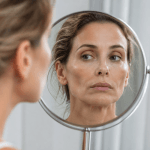
The face is often where rapid weight loss shows first and most cruelly. Fat in the cheeks, temples and around the jawline thins, the skin loses support, and the result is a gaunt, hollow appearance that can make a person look prematurely aged. The media has labelled this “Ozempic face”. The label is catchy, but the underlying problem is not the drug. It is the loss of facial fat combined with overstretched skin, exactly the same pattern that appears anywhere else on the body, just more visible.
Restoring lost facial volume
The first step in many cases is restoring the volume that has been lost. Options include:
- Fat transfer (lipofilling): the patient’s own fat is harvested from another area and grafted into the cheeks, temples and jawline. The advantage is a natural, long-lasting result using your own tissue.
- Dermal fillers: hyaluronic acid fillers can restore volume in a less invasive, non-permanent way. Useful for moderate volume loss or for patients who want to “trial” a look before committing to fat transfer.
Tightening loose facial skin
When the laxity is mild to moderate, minimally invasive options such as Endolift can tighten skin without surgery. For more significant laxity along the jawline and neck, the most reliable answer is a facelift, often combined with a neck lift. A modern facelift is not the over-tightened, “windswept” caricature of a generation ago. Done well, it repositions the deeper layers and removes excess skin to produce a result that looks like a rested, slightly younger version of you.
For many post-weight-loss patients, the best facial result comes from combining volume restoration with a lift. Replacing volume alone in skin that is already lax can produce an unnatural, puffy look. Lifting skin that has lost its underlying support can leave a face that is taut but still gaunt. The two work together.
What recovery actually looks like
Recovery varies enormously by procedure and by combination, but a few honest generalisations are worth making.
- Hospital stay: single procedures such as an arm lift can often be done as a day case or with a single overnight stay. Larger combined procedures and body lifts usually require one to several nights in hospital.
- Time off work: two weeks is a reasonable minimum for desk-based work after a major procedure. Physical jobs require longer.
- Compression garments: almost universal after body contouring, worn for several weeks to support healing and reduce swelling.
- Exercise: light walking from the first days, with gradual return to gentler exercise around four to six weeks and full activity by around eight to twelve weeks, depending on the procedure.
- Scars: red and firm initially, then fading over twelve to eighteen months. Final scar quality depends partly on surgical technique and partly on your own healing.
- Final result: a meaningful contour change is visible within weeks, but the true final shape settles over six to twelve months as swelling resolves and tissues relax.
Risks and what to ask your surgeon
Body contouring surgery after major weight loss is well-established and, in experienced hands, has a strong safety record. It is still surgery, and like any surgery it carries risks. The main ones to understand are bleeding, infection, fluid collections (seromas), wound healing problems (more common in larger procedures and in former heavy smokers), blood clots, scar complications, and, in any major procedure, anaesthetic risk.
Two specific issues deserve attention in post-weight-loss patients. The first is nutrition. Patients who have lost large amounts of weight, especially on GLP-1 drugs that suppress appetite, may be relatively undernourished even if their weight looks healthy. Protein, iron, vitamin D and B-vitamins should all be assessed and corrected before surgery. The second is medication management. Current guidance generally recommends pausing GLP-1 medications for a period before surgery because of effects on stomach emptying and anaesthetic safety. Your surgeon and anaesthetist will give you the specific protocol.
Useful questions to ask any surgeon you consult:
- How often do you perform this procedure on post-weight-loss patients specifically?
- Can I see before-and-after photographs of patients with a similar starting point to mine?
- Where will the scars be, and how long will they be?
- What is your protocol around GLP-1 medications and nutrition before surgery?
- What is your complication rate, and how do you handle complications when they occur?
- Will my procedure be staged, and if so, why?
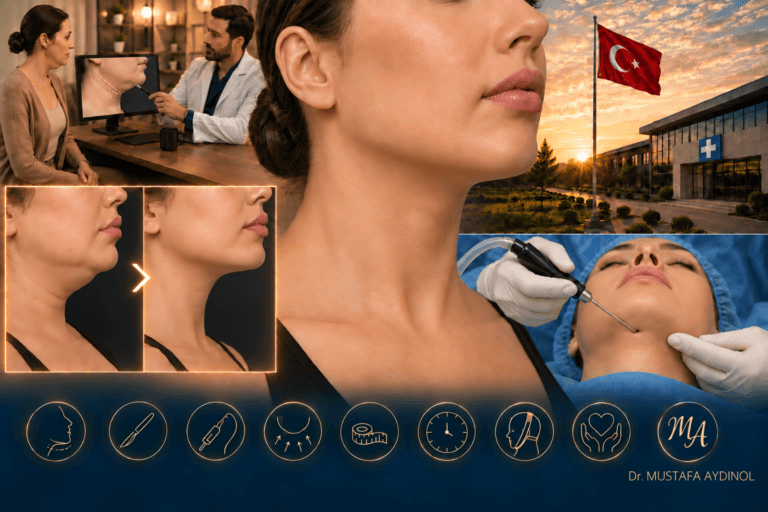
Post-weight-loss surgery in Istanbul with Dr Mustafa Aydınol
If you have done the hard work of losing the weight and are now considering surgery to address the skin that has been left behind, the choice of surgeon matters more than any other single decision. Post-weight-loss surgery is technically demanding. The tissues behave differently from those of a never-overweight patient, the operations are longer, and judgement about how much to remove, where to place scars, and how to stage multiple procedures is what separates a transformative result from a disappointing one.
Dr Mustafa Aydınol is a Plastic, Reconstructive and Aesthetic Surgeon based in Istanbul, with extensive experience in body contouring after major weight loss and in facial rejuvenation for patients who have experienced the volume loss that follows it. His international patient base includes people travelling from Germany, Italy, the United Kingdom and France for surgery in Istanbul.
What this means for you as a patient:
- A surgeon-led consultation that assesses you honestly, including whether your weight is stable enough, whether you would benefit from staging, and whether some areas would be better addressed non-surgically
- A surgical plan built around your anatomy, your priorities and your timeline, not a standard package
- Clear information about scars, recovery and realistic results before any decision is made
- Coordinated care for international patients, including pre-operative assessment, surgery, post-operative recovery in Istanbul and structured follow-up after you return home
If you would like a professional opinion on whether you are ready for surgery and what combination of procedures would suit you, you can request a consultation. Share your story, your current weight situation and, where helpful, photographs. You will receive an honest assessment rather than a sales pitch.
Frequently asked questions
Does Ozempic cause loose skin?
Not directly. The loose skin is a consequence of significant, often rapid, weight loss. The faster the loss and the more weight involved, the less time the skin has to retract. The drug is the route to the weight loss, not the direct cause of the skin change.
When can I have plastic surgery after weight loss?
Most plastic surgeons recommend waiting until your weight has been stable for at least six to twelve months. This protects your final result, because further weight loss after surgery can create new laxity, and weight regain can stretch closures and widen scars.
Can loose skin go back to normal on its own?
Mild laxity can improve over time, especially in younger patients. After significant weight loss, however, the skin’s elastic fibres are often permanently overstretched, and surgical removal is the only reliable solution.
What is “Ozempic face”?
A popular term for the gaunt, hollow, prematurely aged facial appearance that can follow rapid weight loss. The underlying issue is loss of facial fat and skin laxity, not the medication itself. It is treated with volume restoration (fat transfer or fillers) and, where needed, a facelift or non-surgical skin tightening.
Will I be left with visible scars?
Yes. Body contouring surgery trades loose, hanging skin for a planned, well-placed scar. Scars fade significantly over twelve to eighteen months, but they do not disappear. For most patients who reach the point of seeking this surgery, the trade is worth it. An honest surgeon will make sure you understand it in advance.
Can everything be done in one operation?
Sometimes. Combining procedures (for example a tummy tuck with an arm lift) is common and reasonable. Very extensive cases are usually safer when staged over two or more operations, several months apart. This is a judgement call made together with your surgeon.
Do I need to stop my GLP-1 medication before surgery?
Most likely yes, for a defined period before and after surgery. GLP-1 drugs slow stomach emptying, which has implications for anaesthetic safety. Your surgeon and anaesthetist will give you the specific protocol.
Is post-weight-loss surgery safe?
In experienced hands, and in a properly prepared patient (stable weight, good nutrition, no untreated medical issues), it has a strong safety record. Choosing a qualified, experienced plastic surgeon is the single most important factor.