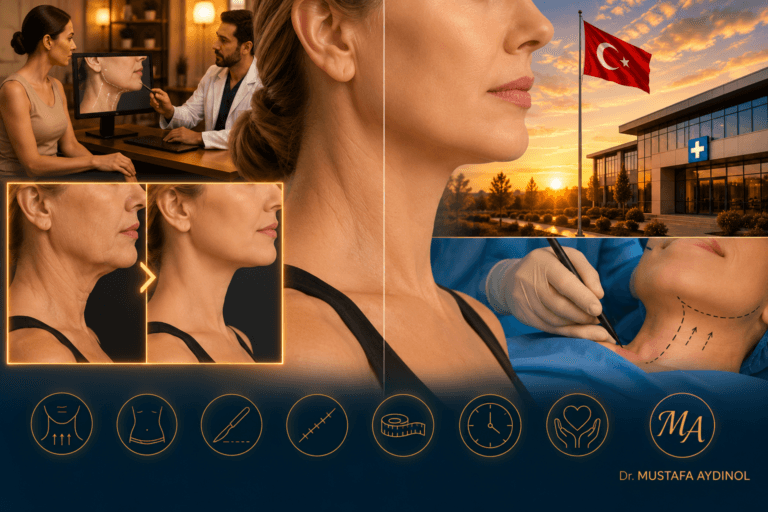


GLP-1 medications have changed weight loss medicine. Millions of patients are losing weight that resisted them for decades, and the health benefits are real. But many of those patients discover an unexpected trade: the body wins, and the face pays. The hollow temples, deflated cheeks and tired expression that follow rapid weight loss now have a popular name, Ozempic face, and a growing number of my international patients arrive asking about exactly this.
This guide explains what is actually happening in the face during rapid weight loss, why creams and time will not reverse it, when fillers make sense, and why facial fat grafting has become the central answer for restoring a face that major weight loss has deflated.
Watch: Ozempic face and facial changes after weight loss
In this conversation with Sibel Aydınol, Dr. Mustafa Aydınol discusses facial volume changes after rapid weight loss and how filler, fat grafting and facelift options are assessed.
· · Spoken in Turkish · Turkish and English subtitles
Video chapters
Select a timestamp to open that chapter on YouTube in a new tab.
- Why plastic surgery after weight loss?
- What does “Ozempic face” mean?
- Timing surgery after weight loss
- Face: filler, fat grafting or facelift
- Abdomen: liposuction or tummy tuck?
- Is liposuction weight-loss surgery?
- Breasts after weight loss
- Arms, legs and surgical scars
- Combining or staging procedures
- Is the body ready for surgery?
- GLP-1 medication before surgery
- Quick questions
- Readiness and expectations
- Planning a visit from abroad
- Drains and massage
- Closing
Read the English transcript
This text follows the published English captions, grouped into paragraphs for easier reading.
0:00 — Why plastic surgery after weight loss?
Why do people turn to plastic surgeons after losing weight? Hello and welcome to our channel. Thank you. Doctor, lately everyone is talking about Ozempic, Wegovy and Mounjaro.
People are losing 15, 20 or 30 kilograms. Shouldn't that be the happy ending? Why do they then find themselves at a plastic surgeon's door? Well, losing weight is a wonderful achievement.
People go through a major change in their lives, and they are happy. But the story does not simply end there. A new chapter begins. This time, they contact us to address the loose skin, and a surgical journey begins.
So today, we are not debating whether Ozempic is good or bad. No, that is not our subject today. Ozempic is also an effective and valuable medication. So, we are discussing life after weight loss, not how to lose weight.
Exactly.
1:01 — What does “Ozempic face” mean?
Then let me ask about the phrase everyone knows: “Ozempic face.” Is it really a thing? It is real, but saying it is as dramatic as… No, that is the wrong wording. Let me put it this way: on social media, people like to give things catchy names and make them popular.
“Ozempic face” became one of those terms. Of course, after losing a substantial amount of weight, a person may look in the mirror and suddenly notice sagging cheeks and changes in skin elasticity. The change can look very striking because people are not used to it. A previously fuller face suddenly becomes much slimmer.
So “Ozempic face” became a trending term. But saying the medication damages the face is an oversimplification. It is too simplistic. The medication is not damaging different parts of the body; rather, the changes occur because of the weight loss.
Could we call it volume loss? Yes, there is loss of volume and elasticity. The entire body can develop loose skin. That is why we have recently seen a marked increase in body-contouring procedures.
I have lost 20 kilograms;
2:07 — Timing surgery after weight loss
can I have surgery immediately? We hear this question often. People ask it a great deal, as you know. Can they?
I advise against it, because I do not think surgery is appropriate before a patient reaches a stable final weight. Remaining at a stable weight for at least four to six months also helps the surgical result last over the long term. It is not a matter of saying, “I have lost the weight, so now I am coming in for surgery.” Reaching your target weight does not automatically mean you are ready. It should not be immediate.
Waiting is beneficial. Do we need to wait? And does the skin sag more while we wait? That is somewhat debatable and also depends on what the patient does.
Exercise may provide a small degree of improvement, but suppose your skin has already become loose. If you say, “I am afraid of surgery, so I will wait one or two years and exercise until my skin tightens,” unfortunately that does not happen. Skin does not work that way. Some patients do, of course, try nonsurgical treatments to tighten their skin, and these can provide some improvement.
Exercise may also help the skin recover to a certain degree, but unfortunately it will never achieve the same result as surgery. Now there is also
3:27 — Face: filler, fat grafting or facelift
the face. A patient says, “My face looks hollow.” What should we do: filler, fat grafting or a facelift? Plastic surgery offers many options, both surgical and nonsurgical. But first we need an accurate diagnosis so that we can choose the right treatment.
If the tissues have sagged, the appropriate treatment is a facelift. That may include a facelift, a neck lift, or lifting other areas that have descended. If the problem is volume loss, fat grafting may be appropriate. Some patients do not want fat, so dermal filler may be an option.
Sometimes both approaches are combined: we tighten the skin with a facelift and restore volume to the cheeks and other areas with fat. Simply thinking, “It looks hollow, so let's fill it,” can be risky. Perhaps not dangerous in itself, but everyone asks, “Can you tighten my skin without surgery? Let's put filler here, then do a skin booster, then this and that.” These methods do not work for every patient.
That is my point. We need to assess carefully, make the correct diagnosis, and choose the right combination. Now,
4:37 — Abdomen: liposuction or tummy tuck?
returning to the abdomen: can't we use liposuction and have the skin tighten as well? I have lost 20 kilograms and my abdomen is a little loose. Could we perform liposuction, remove the fat and let the skin retract? In a very young patient, that can sometimes happen.
But generally, that is not the situation. Many patients have already been through pregnancy, followed by weight loss. Since that is our topic, I am focusing on weight loss. Liposuction literally means removing fat.
When we remove the layer of fat beneath skin that is already loose, the skin may sag even more because it no longer has the same underlying support. That usually needs to be corrected surgically. Some patients may also have weakness in the abdominal muscles. That is a separate issue.
In that case, a tummy tuck may be needed, along with repair of the muscle weakness. Liposuction and a tummy tuck are not different sizes of the same operation. One removes fat; the other tightens the abdomen. They are distinct procedures.
However, when performing a tummy tuck, we often add some liposuction, particularly around the waist. Yes, especially the love-handle area; sometimes the back and abdomen are also contoured with liposuction. The goal is to create harmony. That is the whole point.
Of course, we want a more proportionate result. A tummy tuck alone may leave fat around the waist or back. When patients look in the mirror, they naturally want to like what they see. So, a quick question: Is liposuction
6:06 — Is liposuction weight-loss surgery?
weight-loss surgery? No. Liposuction is never a weight-loss operation. Our goal is not to make patients feel better simply about the number on the scale.
It is intended for patients who have exercised for a long time or are already near their healthy weight, to remove stubborn fat and contour the body. It is not a procedure for losing weight. I imagine we will make a separate video about that. Of course.
It is frequently requested, so we will definitely discuss it. Now,
6:43 — Breasts after weight loss
there is also the breast area. The breasts inevitably lose volume after weight loss. Two questions arise: is the issue volume or position? In other words, have the breasts become deflated, or have they sagged?
Volume loss is usually apparent. When you hold the skin, you can feel whether the breast has lost fullness. In those cases, there are not many options for restoring volume. Fat can be transferred, of course, but an implant is often considered.
Some patients, however, still have enough of their own tissue despite the sagging, particularly those with larger breasts. After weight loss, the remaining tissue may be sufficient to reshape and lift the breast using the patient's own tissue instead of an implant. Many prefer that. Is it more natural and sustainable?
Yes, it is more natural and sustainable, and it avoids some of the potential complications of implants. It does not shape the breast exactly like an implant, but there is comfort in knowing that no implant has been placed. Some patients specifically prefer this. Now, there are also the arms and legs.
After
7:50 — Arms, legs and surgical scars
weight loss, if the skin on the arms and legs is loose, can liposuction remove that looseness as well? As we said earlier, these areas are no exception. There are, of course, skin-tightening methods. These are established options, and we use them when appropriate, such as Renuvion or Endolift.
But if the sagging is severe and the patient says, “I truly want slimmer, firmer legs,” then surgery is required. Surgery does leave a scar, but its result is definitive, which is why some patients choose it. So, after weight loss and liposuction, does the loose skin on the arms and legs—and elsewhere—disappear as well? Or what generally happens to the arms and legs after weight loss?
As we just discussed, they are no exception. Like other areas, they can develop loose skin. When that happens, tightening treatments may be considered, and we do use options such as Endolift and Renuvion. However, if a patient wants a truly firm leg, the treatment is surgical.
That comes with a scar, but unfortunately there is no other equivalent method. For genuinely loose skin, the definitive treatment is surgery. Doctor, compared with the past, are scars less of a concern now? There are laser treatments, scar therapies and silicone sheets.
Yes, as you said, silicone sheets, silicone-based treatments and various lasers have become increasingly popular. Medical micropigmentation can also be performed. In some cases, hyperbaric oxygen therapy may help scars improve further. There are even newer peptide products that some patients use.
We sometimes see remarkably good healing in certain patients; the way their scars mature can be very different. In short, as you said, scars seem to be becoming less of a problem than they were in the past. So can we say this: sometimes less treatment is better, but sometimes choosing only a minor procedure is not appropriate? If a lift is needed, we should offer a lift.
Exactly. When a patient truly needs a lifting procedure but you recommend something else, they trust that it will still give them a good result. Later, once they return home, they see that there is some improvement, but not what they expected. When expectations are not met, the patient is naturally unhappy.
Therefore, if a patient wants a sound, lasting result, they will generally accept surgery. When the patient is psychologically prepared, this does not usually create a problem. Now we have come to a difficult question. The patient has lost a great deal of weight;
10:41 — Combining or staging procedures
there is the abdomen, breasts, arms and legs. “Doctor, while I am in Istanbul, why not have everything done at once?” Some patients arrive saying, “I want this, and that,” listing seven or eight different operations. That is not how it works. The patient's medical assessment always comes first.
Even if a patient requests it, we do not proceed if it is not appropriate. For a suitable patient, however, certain procedures can be combined, provided we remain within established medical standards and safety limits. This can produce very satisfying results. The same standards used around the world apply here as well, and we follow them.
The patient's priorities matter too, don't they? Of course. We take the patient's priorities into account. A patient may request six or seven procedures.
In that situation, we divide them into staged operations and ask the patient which goals matter most so we can plan accordingly. The patient tells us, and we create a plan together. We find common ground and agree on the approach. Excellent.
The patient wants to complete everything in one operation, but the surgeon plans to divide them into two stages. Does that mean unnecessary extra surgery is being recommended? As we just discussed, the aim is to balance benefit and risk. If you place too many procedures into one surgical session, complications may occur.
Recovery may also take longer, giving the patient a poor overall experience. Dividing the plan into stages is intended to prevent this and protect the patient; I do not see that as a disadvantage when staging is appropriate. It can also improve the recovery process. Absolutely.
Now, we often overlook this: a person
12:30 — Is the body ready for surgery?
may look ready after weight loss, but is their body biologically ready for surgery? Let's discuss that side as well. The patient's blood tests and metabolic status are very important. After weight loss, for example, a patient may have low iron.
Does that affect treatment? Yes. Low blood levels matter because the blood may not deliver enough oxygen to the tissues. Vitamin D or B vitamins may also be low, and other minerals may be deficient.
All of these need to be at appropriate levels so the patient can heal properly after surgery and tolerate the operation well. This is a process, and the patient needs to understand it. We explain all of this when patients consult us before surgery. We also emphasize that exercise is very important.
Exercise, nutrition, lifestyle and sleep are all part of the picture and must be considered. Let me turn to another subject. Should a GLP-1 medication be stopped before surgery? We also have
13:33 — GLP-1 medication before surgery
a tool on our website that addresses when medications should be stopped. Patients ask about this frequently. Because these medications are generally prescribed by physicians, if a specialist prescribed a medication and it is medically important, I tell the patient to consult the prescribing doctor. Speaking specifically about GLP-1 medications, they are now commonly used for weight loss.
Ideally, the patient has already completed the weight-loss phase and treatment before coming to us. If the medication is being used for diabetes or another medical condition, the prescribing physician's judgment takes priority. As you mentioned, we also have a tool on our website that includes thousands of medications and is supported by scientific evidence. Patients can use it to check which medications may need to be stopped and when.
Dietary supplements are especially relevant, because some can have a blood-thinning effect. We generally ask patients to stop those two weeks beforehand. There is no universal consensus, but that is the usual recommendation. As you said, supplements with blood-thinning properties may increase bleeding.
We advise patients accordingly to reduce bleeding during surgery. Now I am moving on to the rapid-fire questions. Of course. Yes
14:49 — Quick questions
or no? All right. Maybe. Maybe—we will see.
Ready? Here we go. Liposuction causes weight loss. No.
Exercise can eliminate loose skin completely. No, it cannot. I have lost weight, so I can have surgery immediately. No.
The patient needs to wait. Every sagging abdomen requires a tummy tuck. No, not always. In some cases, we can achieve improvement without a full tummy tuck.
More procedures mean a better result. No, that is not true either. Sometimes the opposite happens, and patients may struggle to recover. It is about choosing an appropriate amount of surgery.
Should I have everything that can possibly be done performed in one operation? No, that should not be the goal. Is a natural look the new aesthetic trend of 2026? It appears so.
That is what patients are currently asking us for. Whether it will last, we do not know, but I believe it would be valuable if it did. Of course, some patients want more dramatic results. They may say, “I want very large breasts,” “I want a very prominent buttock,” or ask for a different eyebrow or eye shape.
We perform those procedures too. But overall, I sense a broader movement toward natural-looking results, and the data seem to point that way as well: sustainable and natural. So, to sum up, when do you consider a patient ideal—
16:18 — Readiness and expectations
when do you say, “Now you are ready for surgery”? If we are speaking specifically about weight loss, the patient should have reached their target and maintained a stable weight for about six months. They should also feel physically well and be biologically ready, which needs to be confirmed with laboratory tests. At that point, I consider the patient ready for surgery.
They must also understand what they want. Some patients are undecided, ask many questions or feel very anxious. Psychological readiness matters as well, and it has a significant effect. When all these optimal conditions come together and the patient consults us, if our evaluation shows that everything is in order, surgery can proceed.
So can we move beyond the dilemma of “Change me” versus “Make me look like myself again”? I generally favor, “Make me look like a younger, improved version of myself.” A better version of me. Yes, that is closer to my approach. But as we said earlier, if a patient asks for a transformation, we do not automatically refuse it, provided it remains within reasonable limits.
Safety always comes first; patient safety is far more important to us. We have a planning tool about this on our website,
17:40 — Planning a visit from abroad
but I would also like to discuss it here. How should an international patient plan how long to stay in Istanbul, the final check-up, and when to book the flight? They do not need to plan it alone; we organize it for them. Depending on the operation, we generally recommend staying in Istanbul for five to seven days.
Sibel arranges the hotel, transfers, final and initial check-ups, consultation and hospital admission. We take care of the surgery itself. Another frequent question is: what happens if a patient has a problem after returning home, and how do we proceed? Patients generally receive medical travel insurance.
Before they leave, we take every precaution to prevent problems and complete all necessary checks. This includes follow-up examinations, antibiotics and other medication, and meticulous care during surgery. Usually nothing happens after they return home. If there is a minor wound-healing issue, the patient can generally attend a local healthcare provider through the arrangements covered by their insurance.
If they need to return to Türkiye for treatment by us, we are here and provide every form of support. Our phone line is always open—we simply cannot answer while we are asleep. Otherwise, patients can reach us at any time. I would also like to mention what happens after
19:04 — Drains and massage
the operation, once the patient has been discharged and returned to the hotel. We begin a massage program and use drains. Particularly after liposuction, the first three days are important for removing fluid. What should we tell our patients about this?
I believe a drain is useful after liposuction because a certain amount of fluid inevitably remains inside. A drain allows that fluid to leave the body in a cleaner, more controlled way. It also allows fluid mobilized during massage to collect in a closed reservoir. For that reason, we generally keep the drain in place for two to three days.
Massage is also important. Patients should have at least three or four sessions while they are in Türkiye to help the skin settle smoothly. Think of wrinkled fabric after washing: we iron it to smooth it out. Massage is like ironing the skin.
That is a good analogy. Exactly.
20:10 — Closing
Thank you very much. Thank you for this enjoyable conversation. See you in another episode. I am sure we will, because there is so much more to discuss.
Have a good evening, and keep watching. Good evening. See you next time. Bye-bye.
Bye-bye.
What is Ozempic face?
Ozempic face is not a medical diagnosis and not a side effect unique to any single drug. It is the popular name for a pattern: accelerated facial aging that appears after rapid, significant weight loss, whatever caused that loss. Semaglutide and tirzepatide made the pattern common enough to earn a nickname, but bariatric surgery patients and determined dieters have always known it.
The mechanism is simple and mechanical. The youthful face is shaped by compartments of deep and superficial fat that support the skin like the filling of a cushion. When you lose a large amount of weight, you do not get to choose where the fat leaves. The facial compartments deflate along with the abdomen, and the skin envelope that used to be supported now has less to rest on. The result reads as age: hollowness, shadows, looseness and a tired expression that sleep does not fix.
One point worth stating clearly: this is not a reason to avoid treating obesity. The metabolic benefits of weight loss outweigh the aesthetic cost of a deflated face in every serious medical calculation. The correct framing is different: the face is a solvable, well understood problem, and solving it should not involve regaining the weight.
Why rapid weight loss ages the face
Three factors decide how strongly the pattern appears:
- Speed of loss. Gradual loss gives the skin time to retract. GLP-1 medications often produce loss faster than the skin of an adult face can follow, especially in the second half of life when collagen production has already slowed.
- Amount of loss. The more total volume leaves the facial compartments, the more visible the deflation. Patients losing a substantial share of their body weight see the strongest changes.
- Age and skin quality. A face in its twenties usually snaps back. A face in its forties or fifties, with sun history and thinner dermis, often does not. This is the same biology that governs loose skin after weight loss elsewhere on the body; the face is simply where it shows first and hides least.
The typical signs
Patients describe it before they can name it: “I look older than before I lost the weight.” The usual pattern includes hollowing of the temples and cheeks, deepening of the tear troughs and under-eye shadows, more visible nasolabial folds, early jowling along the jawline, and a general loss of the smooth convexity that reads as youth. Around the eyes, deflation can unmask or worsen hooding and hollowness, which is why some patients end up discussing eyelid surgery in the same consultation.
Importantly, two different problems hide inside this picture: lost volume and loose skin. Every honest treatment plan starts by separating them, because they have different answers.
The treatment ladder: from skin quality to surgery
Step one: skin quality
Rapid weight loss stresses the skin itself, not only the volume beneath it. Regenerative approaches that improve skin thickness and elasticity, discussed in detail in our guide to exosomes, stem cell facials and skin longevity, make every later step work better. For mild laxity with minimal volume loss, energy based tightening such as Endolift can be enough on its own.
Step two: fillers, and their limits
Hyaluronic acid fillers are a reasonable first step for small, localised corrections: a tear trough, a single hollow. Their limits appear when the whole face has deflated. Restoring a globally deflated face with synthetic filler requires large quantities, repeated indefinitely, and faces treated this way often drift toward the overfilled look that patients fear most. A newer category of injectable fat based products now sits between classic fillers and surgery, and we cover it separately in our guide to fat based fillers such as alloClae and Renuva.
Step three: facial fat grafting, the central answer
Fat grafting, also called fat transfer to the face or lipofilling, replaces what was actually lost: fat, with fat. A small amount of your own fat is harvested with gentle liposuction, usually from the abdomen or thighs, purified, and injected in fine layers into the deflated compartments: Temples, cheeks, tear troughs, and along the jawline where support is needed.
Why surgeons favour it for the post weight loss face:
- It is your own tissue. No synthetic material, no repeated purchases of volume.
- It treats the whole face in one session. The deflation of Ozempic face is global, and fat grafting is the tool built for global restoration.
- The surviving fat is living tissue. A portion of the graft is resorbed in the first months, which the surgeon plans for. What survives gains its own blood supply and stays, aging naturally with you.
- It carries regenerative passengers. Transferred fat is rich in stromal cells that improve the quality of the overlying skin, an effect patients notice as texture and glow, not only volume.
The judgement lies in restraint. The goal is to restore the face you had before the weight loss, not to build a new one. Overfilling a face is the fat grafting equivalent of overtightening a facelift, and it is why technique and aesthetic judgement matter more than the concept itself.
Step four: when lifting is honest
Volume restores a deflated face; it does not reposition a fallen one. When the jawline and neck show established sagging, adding volume alone can make the face heavier rather than younger. The honest answer there is a lifting procedure, covered in our guide Ten Truths About Facelift, very often combined with fat grafting in the same operation. Recent clinical research points the same way: combining surgical lifting with minimally invasive and regenerative techniques in one plan produces better facial rejuvenation results than either approach alone. In practice, the modern post weight loss facial plan is frequently exactly that combination: lift where structure has fallen, graft where volume has left, treat the skin above both.
Who is a good candidate, and when
The single most important rule: operate on a stable face. Fat grafting planned while your weight is still falling is planning on moving ground; volume placed today can look wrong after another significant loss. The right moment is when your weight has been stable for a few months. If you are using a GLP-1 medication long term at a maintenance dose, that is compatible with surgery; the perioperative details, including how the medication is handled around anaesthesia, are coordinated with the physician who manages it.
Beyond timing, candidacy follows the usual rules of elective surgery: good general health, realistic expectations, and enough donor fat to harvest, which even lean patients almost always have.
Recovery and the Istanbul travel plan
| Time | What to expect |
|---|---|
| Day 0 | Surgery, usually as a day case, under sedation or general anaesthesia depending on scope. |
| Days 1-5 | Swelling and some bruising in the face and the small donor area. Discomfort is mild; most patients describe fullness rather than pain. |
| Days 5-7 | Follow-up visit. As a single procedure, most international patients are cleared to fly at this point, so book your return flight at least 5 to 7 days after the surgery date, ideally on a flexible ticket. |
| Weeks 2-4 | Social confidence returns; the face still carries some extra fullness by design. |
| Months 3-6 | The resorption phase completes and the final, stable volume becomes visible. |
When fat grafting is combined with a facelift or eyelid surgery, plan a stay of at least a full week; the combined operation heals on the slowest component’s schedule.
What determines the cost
Rather than a single figure, understand the variables:
How many facial areas are treated,
whether the fat grafting stands alone or is combined with lifting or eyelid surgery,
the anaesthesia and facility,
the scope of care around the operation, from preoperative testing to structured follow-up after you fly home. For international patients, the Istanbul model is typically an all inclusive package covering surgery, accredited hospital, hotel, transfers and follow-up as a single plan. Exact pricing always follows an individual consultation, and quotes dramatically below the market deserve suspicion rather than excitement: in facial surgery, the hands are the product.
Frequently asked questions
- Does Ozempic face go away on its own?
- Not usually. The lost volume is lost fat, and unless significant weight returns, it does not come back by itself. Skin quality can improve with care; the deflation itself is treated with volume restoration.
- Fillers or fat grafting: which should I choose?
- Fillers for small, localised corrections or a reversible first step. Fat grafting when the deflation is global: one session, your own tissue, long lasting result.
- How long does fat transfer to the face last?
- Part of the graft resorbs in the first months, by design. The fat that survives is permanent, and the result is measured in years. Your face continues to age naturally on top of it.
- Can I have surgery while still on Ozempic or Mounjaro?
- Yes, once your weight is stable. The medication itself is managed around the operation in coordination with your prescribing doctor. Operating during active, ongoing weight loss is what we avoid.
- Will fat grafting fix my sagging jawline?
- Volume improves mild laxity, but established sagging is a lifting problem. Many post weight loss patients get the best result from a combined plan: lift plus graft in one session.
- How many days do I need in Istanbul?
- About 5 to 7 days for fat grafting alone; book the return flight at least that long after the surgery date. For combined operations, plan a full week or more.
Lost the weight, and the face went with it?
Send your photographs for a personal assessment by Dr Mustafa Aydınol. You will receive an honest opinion on whether skin treatment, fat grafting, a lift, or a combination fits your face, and a realistic plan for your week in Istanbul. Request a consultation.