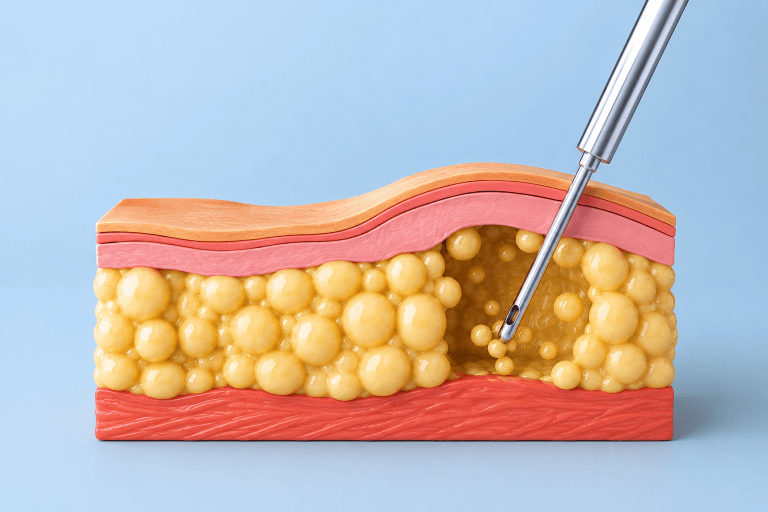


A tummy tuck, or abdominoplasty, removes excess skin and fat from the abdomen and, where needed, repairs the abdominal muscles that pregnancy or weight change have pulled apart. It is the operation that diet, exercise and non-surgical tightening cannot replace once the skin has stretched beyond its ability to recover. What it is not is a single, standard procedure: there are five distinct versions, and choosing the right one for the patient in front of me matters more than anything else on this page.
Abdominal contouring, alone or as part of a combined body contouring or post-weight-loss plan, is a core part of my practice. This page explains the types of tummy tuck I perform, how I decide between them, what happens during the operation and the week in Istanbul, and what a tummy tuck in Turkey involves in practical terms.
Questions about tummy tuck surgery?
Ask about assessment, recovery, costs and follow-up in Istanbul. Suitability is decided during a medical consultation.
Watch: Liposuction or tummy tuck?
In this conversation with Sibel Aydınol, Dr. Mustafa Aydınol discusses how fat, loose skin and abdominal muscle separation decide between liposuction and a tummy tuck, along with scars, drains, compression garments and recovery.
· · Spoken in Turkish · Turkish and English subtitles
Video chapters
Select a timestamp to open that chapter on YouTube in a new tab.
- Opening: liposuction or tummy tuck?
- Is it fat, loose skin or the abdominal muscles?
- Subcutaneous fat and visceral fat
- Which procedure suits which patient? Two examples
- How liposuction works and what it changes
- Does the amount of fat removed measure success?
- How does the skin retract after liposuction?
- Nonsurgical abdominal tightening: expectations and limits
- VASER, laser and 360 liposuction
- J-Plasma and Renuvion: can they replace a tummy tuck?
- Mini or full tummy tuck?
- What does abdominal muscle repair mean?
- Diastasis recti and hernia: what is the difference?
- How is the belly button reshaped in a tummy tuck?
- Where is the scar, and how does it heal?
- Caesarean scars and stretch marks
- Can liposuction and a tummy tuck be combined?
- Surgical risks and health assessment
- Pregnancy, major weight loss and future pregnancy plans
- The abdomen after Mounjaro or Ozempic weight loss
- Preparing for surgery: weight, nutrition and medication
- Recovery, movement and returning to daily life
- Compression garments, drains and drainless surgery
- Swelling and massage: does everyone need it?
- Which symptoms need immediate medical attention?
- Quick questions: weight gain, cost and expectations
- What should we ask at a consultation?
- Next episode: breast lift and implants
Read the English transcript
This text follows the published English captions, grouped into paragraphs for easier reading.
0:00 · Opening: liposuction or tummy tuck?
Hello. Hello. Welcome to our programme. How are you, Doctor? I’m well. How are you? We’re well, too. Thank you. Doctor, some patients cannot decide between liposuction and a tummy tuck after weight loss. What determines that choice? The patient’s anatomy, loose skin, amount of fat and lax abdominal muscles are all important factors. A patient who wants to avoid scars may think liposuction can also address excess skin. How do you approach that expectation?
Managing the patient’s expectations is important. Of course, sometimes we have methods that can meet their wishes. If they are suitable, we can use them. I’m Sibel Aydınol, the clinical coordinator. I’m Dr. Mustafa Aydınol. We promised this in our first episode. Today: liposuction or a tummy tuck? That’s our topic. Yes, today we’ll explain liposuction and tummy tucks in detail. We’ll also cover important questions to ask during your consultation. As you know, we develop your individual treatment plan together, during and after your examination.
1:06 · Is it fat, loose skin or the abdominal muscles?
When a patient says, "I have a belly," what do you look at first? First, we need to understand what they mean by that. Are the muscles lax? Is there an issue with the skin or with the underlying fat? We need to assess each of these individually. A muscle problem needs one treatment; excess fat needs another. Sometimes all three occur together. We need to plan treatment accordingly.
1:35 · Subcutaneous fat and visceral fat
Let’s distinguish fat under the skin from fat around the organs. How does that affect what liposuction can achieve? Well, conventional liposuction only addresses fat under the skin. During liposuction, we never touch the fat behind the muscles, around the organs. So if a patient has visceral fat, liposuction cannot treat it. Is a mirror or a photograph enough to tell the difference? It can help to some extent.
We already ask patients to send photographs. We ask you to send photographs. More or less, we can get an idea from them. But they cannot replace a detailed examination.
2:20 · Which procedure suits which patient? Two examples
Let’s consider two examples. The first patient’s weight has been stable for a while. There is fat around the waist, but no obvious folds of skin. What would we think? Well, we shouldn’t generalise, but these patients may have a more athletic lifestyle. If their skin quality is good, they are young, and their skin’s collagen and elasticity are good, fat removal alone may be enough. If the skin isn’t very loose, a tightening procedure might also help. Let’s look at the second person.
She’s back to her pre-pregnancy weight but has a fold of skin on her lower tummy. She also says, "Let’s remove the fat." Again, how much the skin sags matters. Some patients are particularly concerned about scars. If there is a lot of loose skin, a tummy tuck may be the answer, but, as I said, we need to assess how much. Are there any problems with the abdominal muscles?
These are important factors in the decision. So is the decision based more on the tissues than on childbirth history? Of course, pregnancy doesn’t affect every woman in the same way. Some gain more weight; others gain less. Some have stronger abdominal muscles or other medical conditions, and so on. What matters more is the patient’s current condition. How much has the skin loosened with weight changes? How much fat is there?
The condition of the skin and muscles matters in men, too. So, during consultations, before naming an operation, we should assess what the patient wants to change. Yes, patients need to ask about that. They should say, "Doctor, this is what I want to improve," so we can plan treatment accordingly and help them.
4:19 · How liposuction works and what it changes
Could we explain to our viewers how liposuction is performed? We generally make small incisions in areas covered by underwear and introduce a fluid. That fluid helps reduce both bleeding and pain. After waiting a little, we use hollow tubes and suction to draw out and remove the fat. Our aim is to shape the body, not to achieve weight loss.
4:53 · Does the amount of fat removed measure success?
The amount removed is sometimes seen as a measure of success. Yes, on social media you hear, "We removed 16 litres," or "15 litres." Some patients really do have very stubborn fat. It doesn’t go away after treatment or weight loss. Or, let’s say, their lifestyle isn’t suitable. For these patients, this can offer relief. But their health is important. If their body can tolerate it and bleeding can be controlled, it can be done. We take certain precautions during the operation.
But it isn’t something we recommend in every case. The patient’s overall health is the main deciding factor. And it varies with each patient’s circumstances. Of course. We proceed with precautions.
5:42 · How does the skin retract after liposuction?
Let’s move on to skin elasticity. How does it affect the appearance after fat removal? As we mentioned, if the collagen is good, once the fat is removed, some space is left in that area, and the skin goes through a period of adaptation. Good collagen and elasticity make that easier. But if there are stretch marks, loose skin, or a loss of those elements, the skin cannot adapt to that space, so it may sag further.
How do you discuss the options with a patient who doesn’t want to accept a scar? If they won’t accept one at all, I think we should explain. We need to be realistic. "There is another method, but it isn’t like surgery. Your expectations need to reflect that. Please understand this." I would want the patient to think it over. They don’t always have to have surgery.
They may decide against it, postpone it or take time to think. I think those are valid decisions, too.
6:54 · Nonsurgical abdominal tightening: expectations and limits
Various treatments are advertised as a "non-surgical tummy tuck." How should we distinguish fat reduction from skin tightening? There are fat-freezing methods, as you know, and different laser treatments. "Non-surgical" is often presented as an advantage, but I don’t think that means much if it doesn’t deliver the desired result. With the necessary precautions and assessments, I think patients can get good results. I just don’t think it should be presented as inherently superior.
There are different devices. For patients with a pronounced skin fold, what are their limits, and how should they be used? What matters is how loose the patient’s skin is and how much the device can actually help them. Most of these treatments require several sessions, as they aren’t surgical. Laser treatment might take four or five sessions; the same goes for fat freezing. We need to explain this and make sure patients are properly informed.
For example, if there is some loose skin above the navel, laser treatment can genuinely improve it to some extent, but it takes sessions. It takes patience. It takes patience. The patient needs to be prepared for that. Results can be encouraging, but selecting suitable patients is crucial. Patience and time are essential. What do we think about directing a patient who is reluctant to have surgery towards a device first? Patients ask, "Doctor, I don’t want surgery.
I’d really prefer no scar." Let’s not say "absolutely no scar." Yes, a patient can be referred for that. But if it isn’t the right treatment, they lose both time and money. I think we need to explain that. Sometimes that option simply makes the patient more unhappy. Surgery might get them to their desired result sooner. Meeting expectations. Yes, meeting expectations is important. Does the word "non-surgical" make people overlook the risks?
I think so. People say, "There’s no surgery. I won’t have general anaesthesia. I’ll get a wonderful result." But sometimes they get neither that result nor the smooth experience they expected. There can be pain, burns, pigmentation changes, or an unsatisfactory result. The money may have been wasted. Sometimes, after fat is lost in that area, it can also return more quickly. That’s another risk. Now, VASER, laser, 360-degree liposuction and similar terms influence people’s decisions. They get confusing. How do we distinguish the technology from the scope of treatment? Each procedure has its place.
9:41 · VASER, laser and 360 liposuction
And there are ways to use them together. Since you’ve asked about each one, let me explain. VASER is a device that uses ultrasound energy. It is used as a preliminary step. It helps soften the fat cells. Laser has a similar effect. Laser also destroys fat cells by breaking them down. VASER uses ultrasound energy, so it is somewhat gentler. The cell survival rate is a little higher.
They have different uses. As I said, before the operation; then we use the hollow tubes I mentioned to remove the fat. So VASER is actually a surgical method, too. Of course. We use VASER before and during surgery. To distinguish it from non-surgical device treatments, how does it work? Rather than "non-surgical," if a patient doesn’t want general anaesthesia, it might be performed under local anaesthesia. That can be possible, too.
Yes, exactly. Which areas are covered by the term "360"? "360" generally refers to the area from the waist up. It covers the abdomen, back and waist, all the way around the upper body. The meaning is in the name. There’s no extra surgery. Just 360 liposuction. What should patients ask beyond the name of the device? I think that’s a good question. Patients abroad ask us, "Do you perform VASER liposuction? Do you have a laser?
Do you use plasma or Renuvion?" Those aren’t the key questions. What matters is: "How much will your procedure improve my concern? How happy will I be? What might arise? What will remain?" Will it meet expectations? Yes, will it meet expectations? I think it’s more useful to understand the extent of treatment and what will be done than to focus on the technology.
11:59 · J-Plasma and Renuvion: can they replace a tummy tuck?
We touched on J-Plasma. Let’s discuss it now. In which patients does adding J-Plasma or Renuvion affect the decision to have a tummy tuck? Well, it doesn’t actually change that decision. If a tummy tuck is needed, it’s a major operation in its own right. Renuvion simply doesn’t have that capability. But say there is mild sagging above the navel, or the patient’s skin elasticity is somewhere in the middle.
Little sagging, but they want tightening. Renuvion can be used in that situation. So here’s a question. How do the amount of skin and the expected change affect the choice? That’s what I was just explaining. A patient might say, "Doctor, a slight improvement would be enough, but I don’t want a scar. My body is already in good shape. Just a little contouring would do." "My tummy doesn’t have to be completely flat."
Yes. If they accept that some wrinkling may remain and are mentally prepared for that, I think Renuvion is a suitable choice. It works better in younger patients. Yes, it works better in younger patients. For example, if a woman has had five or six children and has extensive stretch marks on her abdomen, Renuvion doesn’t make much sense. Then we would consider surgery. Some patients still request it even then, but it’s worth explaining what results they can expect.
Let’s also make clear that this involves working beneath the skin. I’m referring to Renuvion. Some patients ask, "Doctor, is that surgery, too?" Yes, it is. It doesn’t have to be a lot, but first we need to do some liposuction to create space so Renuvion can work. What matters for safety here? Again, the usual considerations when assessing patients: Are they in good health?
Is there anything that would prevent them from having surgery? Has their weight loss stopped? Is their condition stable? We need to consider all of these.
14:07 · Mini or full tummy tuck?
A patient who wants a shorter scar may consider a mini tummy tuck. What findings make a mini tummy tuck suitable? Patients requesting one generally don’t have extensive sagging. When they sit down, there is usually some loose skin below the navel. It can suit those patients, but a mini tummy tuck doesn’t mean a risk-free procedure. The word "mini" sounds more appealing, but as we’ve said throughout, if it doesn’t deliver the desired result, the patient can be unhappy with a mini tummy tuck, too.
How does the plan change if the upper abdomen is also noticeably loose? A mini tummy tuck won’t help there. We need to consider a reverse tummy tuck. Or if the problem is extensive, it’s worth considering a standard tummy tuck. That was the case with a patient we operated on last week. They’d had liposuction. There was a substantial amount of loose skin above the navel.
They were 60. It looked wavy. Exactly, a wavy appearance. We performed a standard tummy tuck.
15:16 · What does abdominal muscle repair mean?
One very common question concerns the term "muscle repair." It can sometimes be misunderstood. Which tissue are we actually tightening in abdominal muscle repair? We really are repairing the abdominal muscles here. But patients sometimes think that muscle repair, or something they feel they don’t need, is unnecessary. However, after childbirth or major weight loss, there can be laxity in this area. Perhaps "bringing them together" is more accurate than "repairing."
In some patients, the abdominal muscles have actually separated after childbirth. It goes beyond laxity. Right in the middle… Particularly after multiple pregnancies… It’s no exaggeration to call it an empty strip. In those cases, it can reach the point of requiring a repair. Generally, we pass stitches through the muscle covering, bringing the muscles together to strengthen that area. That’s the right description. Here’s another related question.
16:26 · Diastasis recti and hernia: what is the difference?
Diastasis. Diastasis and a hernia. How do you distinguish them? How does that affect treatment decisions? We establish a definite diagnosis of diastasis using imaging such as ultrasound or a CT scan. But the patient may give us clues: multiple pregnancies, large weight gains and losses, for example. Twins. Yes, twins or triplets. That already points us towards diastasis. In some patients, it is extensive enough to cause symptoms, so they have already had an ultrasound.
They send us the report. It states the extent of the separation. A hernia is different, because it means tissue from inside the abdomen protrudes through. Treatment can vary according to the size of the hernia. The good news is that both can be treated in the same operation. So, if we have those problems, they can be addressed together during a tummy tuck. Another question concerns the navel.
17:27 · How is the belly button reshaped in a tummy tuck?
The appearance of the navel. How is it reshaped in a full tummy tuck? Of course, we preserve the navel’s own structure. We don’t cut it out and discard it, but we need to free it from the skin. That’s why we make a circular incision around it. Then we bring it through a new opening in its anatomical position. That leaves a small scar around the navel.
Its shape can be round or oval. Some want it oval, some round, some narrow. A recent patient specifically asked for an oval navel. So we made it oval.
18:09 · Where is the scar, and how does it heal?
Another question we hear very often concerns the lower scar. Where does that scar sit? I specifically tell patients: "Please come wearing your favourite underwear, or the kind you wear most often." We make our markings to fit it as closely as possible. Of course, if you pull your underwear up, the scar may show, but when worn normally, it is generally concealed underneath. Could we also suggest bringing bikini bottoms?
Of course. They can bring different styles. If there are suitable overlapping lines, we can plan the scar accordingly. What expectations should we set when explaining how a scar changes over time? A scar is permanent; it never disappears completely. Genetics can mean faster or slower healing, or a better or worse scar. Some become raised, some don’t, and some turn pale very quickly. Sometimes the ends of our stitches can be visible. But the good news is that they all heal in some way. Silicone creams and tapes can help manage scars. Laser treatments are available.
If a scar becomes raised, we sometimes inject steroids into it. With measures like these, a scar can eventually become almost invisible. If the patient is still very bothered, they can have micropigmentation or a tattoo. But laser treatment should be tried over several sessions. I recommend a course of sessions. If the patient is nearby, or there is a laser centre near where they live, it can certainly help.
19:50 · Caesarean scars and stretch marks
There is also the C-section scar. Where do C-section scars and stretch marks fit into the plan? As far as possible… Actually, I’ve never done otherwise. I shouldn’t say "as far as possible." I include the C-section scar so there is just one scar. Of course, if it’s in a difficult position, some deviation from the usual incision line is unavoidable. Otherwise, there is just one scar.
As for stretch marks, those on the skin we remove go with it. But we can’t do anything about those above that line. They remain. Perhaps laser treatment for those, too. Laser, mesotherapy, yes, such treatments are possible. They may be needed. So discussing the scar’s position is as important as discussing the change in shape. Exactly.
20:36 · Can liposuction and a tummy tuck be combined?
Exactly. If waist fat and excess abdominal skin occur together, when do you plan both procedures in one operation? We generally combine 360-degree liposuction with a tummy tuck. Very occasionally we don’t, if the patient is slim. But generally, patients come in concerned about fat around their waist. So they are done together. But the situation can vary. When is it more important to perform the procedures in stages?
We very often combine 360-degree liposuction and a tummy tuck, but there may be a significant bleeding issue. Something may prevent anaesthesia. Then we can separate the procedures. That applies to every operation.
21:15 · Surgical risks and health assessment
Right. One of the questions I hear most concerns risks. Which risks frighten people most, and what problems could occur? We’d like to discuss them. Of course, there can be infection or bleeding, or an embolism, where a blood clot travels. But we take precautions against all of these. We put anti-embolism stockings on the patient. We give medication to help prevent blood clots. Our anaesthesia team is on standby.
We do whatever modern medicine requires. With these measures, we generally don’t encounter very serious adverse events or complications. Wonderful. What health information should patients share for a safe plan? Previous surgery, their medications, and any family history of illness are important. We need to know these things. Any previous surgery? Did they experience any problems with it? The more information we have, the better.
Right? If they’re taking medication, what about starting or stopping it? They shouldn’t decide on their own. Some drugs are critical. For example, patients with a heart condition often take blood thinners. They absolutely need to discuss these with their own doctors. Stop and restart only after discussing it. We can decide on some medications ourselves, but these critical ones are important. Right.
22:44 · Pregnancy, major weight loss and future pregnancy plans
Do we assess someone after childbirth differently from someone who has lost a lot of weight? Muscles and loose skin are the key points. Someone who has lost a lot of weight may come in with loose skin. Someone after pregnancy may have muscle separation. I think it makes sense to plan treatment accordingly. If the loose skin extends to the sides, is a standard tummy tuck enough?
In that situation, we extend the tummy tuck incision towards the back. If the standard is 180 degrees, we might call this a 270-degree tummy tuck, or an extended tummy tuck. Some patients lose 50 or 60 kilograms. Their abdominal skin also sags sideways. Then we can perform a vertical tummy tuck, known as a fleur-de-lis tummy tuck. What can exercise and physiotherapy contribute here?
I think exercise and physiotherapy have a limited role in reducing loose skin. They may improve things a little. For example, they may help tighten lax abdominal muscles to some degree. But with major separation or very significant sagging, unfortunately the treatment is surgery. How do we approach timing for someone planning a pregnancy soon? If pregnancy is planned, I think surgery should wait. The body will change during pregnancy anyway.
Why operate and knowingly allow the result to be affected again a while later? Some change in shape is inevitable. It’s best to go through pregnancy comfortably, then come for surgery.
24:34 · The abdomen after Mounjaro or Ozempic weight loss
Let’s return to the medications from our first episode. Mounjaro and Ozempic. What do we look at when assessing abdominal concerns in someone who has lost weight with these? They affect skin quality quickly, so skin elasticity matters. We need to assess how much sagging these medications have caused. If they haven’t caused much sagging, then instead of a tummy tuck, liposuction and J-Plasma may be possible. But if the sagging is substantial, then a tummy tuck. We should consider surgery.
25:12 · Preparing for surgery: weight, nutrition and medication
Does reaching your target weight mean you’re ready for surgery? As we said, reaching your target weight doesn’t mean you’re ready for surgery. You need to maintain a stable weight. You need to maintain your lifestyle. It’s about consistency. Not, "I’ve reached 75 kilograms, so I’ll have surgery immediately." You need to stay at that weight for several months. Why is assessing nutrition separately important during this time?
There can be mineral and vitamin deficiencies, reduced protein levels and iron deficiency. All of these affect healing. So patients need to be aware of this and take care. I’ll return to something we discussed earlier. Which doctors should help plan medication before surgery? For gynaecological medication, for example, with a gynaecologist. For heart medication… Hormone treatment, for instance. Yes. For heart medication, with cardiology. If they’re taking psychiatric medication, then with psychology. These critical medications must be assessed.
26:22 · Recovery, movement and returning to daily life
Right. This is another frequently asked question. Work and home arrangements. They need to be planned. Returning to daily life. Which activities do we consider separately? Not every job is the same. Someone who stays at home may return to their routine sooner, but if they have a physically active job, it will take longer. We’re talking about a period of weeks. A tummy tuck requires at least four to six weeks of recovery. When planning time off after a tummy tuck, what timeline do we discuss? The skin takes about a month to heal.
Afterwards, patients use silicone scar tape, and the scar gradually becomes less noticeable over the years. We explain that to patients throughout this period. Of course, after a while, wound healing slows, so if they can come to us or go somewhere themselves, laser treatment can be more helpful. Another critical point: rest versus early mobilisation. After surgery, we start at around four hours, once the patient feels well, and we tell them to walk. Walking early is important for their overall health and their recovery.
Returning to an active life varies from patient to patient, but I think they should keep up daily activities without overexerting themselves. It reduces their stress levels and helps them feel better. How does early swelling affect a patient’s assessment of the result? Patients can really panic. "Doctor, this is swollen. Something looks strange. Will it stay like this?" I see that online often, too.
Most early swelling like this goes away in the longer term, or even in the medium term. So I think it’s best not to judge too early and panic.
28:24 · Compression garments, drains and drainless surgery
An important topic we need to cover: compression garments. Drains. What do they each do? A compression garment isn’t intended to make the body slimmer. Some patients don’t want to wear one. That’s quite normal. Its purpose is to help the patient manage or clear the remaining swelling and fluid more comfortably. A drain similarly collects fluid that builds up after surgery in a more hygienic, controlled way.
Without a drain, the fluid either leaks out, leaving blood on the garment and making a mess, or, if the opening is closed, it builds up inside and causes bruising. That’s why I think a drain is necessary. A garment’s purpose is sometimes confused with getting a slimmer waist. No. That’s not what it does. This is how we understand its actual purpose. Why shouldn’t someone follow another patient’s schedule for wearing a garment?
Each patient is different. A liposuction patient and a tummy tuck patient, for example, are different. We shouldn’t rely on hearsay. Yes, that happens a lot. Drains also frighten patients a little. Yes, but removing them is virtually painless, and they’re actually helpful. I very rarely see problems with drain removal. There’s no need to be afraid. Can the word "drainless" be a measure of quality on its own?
Not for every operation. I’ve seen many patients treated without drains, with a lot of fluid accumulation and bruising. Of course, it can be done in suitable patients. But I always use drains in my own practice. Let me open another topic.
30:19 · Swelling and massage: does everyone need it?
Swelling and massage: for us, these are all connected. But social media says, "Without massage, your result will be ruined." Does everyone need massage? The role of massage depends on the procedure. I don’t think it’s particularly necessary after a tummy tuck, but after extensive liposuction, yes. Because you remove the fat tissue from beneath the skin. For the skin to reattach smoothly, it needs some energy.
That’s massage: smoothing the skin by hand. The aim is for the skin to heal more evenly. Patients understand its importance when they see it. Let’s say it depends on the operation, rather than saying it’ll be ruined. Yes, it’s important for patients who need it. What findings should we assess before trying to treat swelling with massage? We said earlier that swelling initially upsets patients.
Of course, but not every swelling will go away with massage. Sometimes there can be a dangerous situation. For example, some patients develop a seroma, which is fluid collecting under the skin. Or a haematoma: a collection of blood. If an area swells quickly or painfully, you need to contact your doctor immediately. Call the team straight away. Not every swelling can be resolved with massage.
31:49 · Which symptoms need immediate medical attention?
Which symptoms need urgent assessment without waiting for the scheduled follow-up? Good question. Bleeding at the wound, a stained dressing, chest pain or sudden pain in a leg can indicate serious problems. Please contact your team and doctor as soon as possible. Don’t wait. Your doctor is there for you, wherever you have surgery. Your health is always the most important thing. So having a clear follow-up and contact plan at discharge is very important. The team should always be reachable.
32:36 · Quick questions: weight gain, cost and expectations
Let’s move on to the quick questions. Okay. A few questions before we finish. I won’t wear you out. Let’s see if I can manage. You won’t give long answers. Maybe. The subject is very complex. Let’s see what happens. How does gaining weight after surgery affect the result? Negatively. Negatively. One people may hesitate to ask: when can they resume sex? I think patients should feel comfortable asking, but sometimes they hesitate. They can consider their recovery and listen to their bodies when making that decision.
But if they have concerns, I think they should ask their surgeon whenever they want. To make the right decision. What should patients look at when comparing different price quotes? This happens all the time. As you know, patients ask around as if visiting shops. I think they should ask which procedures will be done and where: a medical centre or a hospital? Is there an intensive care unit?
What’s included in the package: hotel, accommodation, dressings, and so on? I think comparing these is sensible. What do you say to a patient afraid they might regret having surgery? That’s a question with a heavy moral responsibility. I’d never say… Shall we skip this? "Have surgery." I wouldn’t want to say that. I think the question of regret is this: how much will the operation change the patient’s life, affect it, and contribute to it? We need to consider that.
If they think surgery will make them happy and contribute significantly to their life, I think they should have it. Right.
34:33 · What should we ask at a consultation?
Let’s finish with questions to ask at the consultation. What should we ask to know whether the operation meets our expectations? I think the question is this. We mentioned it at the start. "What will you do during this operation? Which technique will you use? And which problem will it address? Will I be happy? Which problem will remain?" I think that’s the key question.
34:58 · Next episode: breast lift and implants
Right. Let’s discuss a similar distinction for breasts in the next episode. Okay. Of course. "My breasts have sagged. I don’t want implants. Reshape them with my own tissue? Do I need implants, or not?" We’ll see. Let’s discuss it. Or after childbirth or weight loss. Some patients come before pregnancy and ask, "Should I do this? I’m planning a pregnancy." We can discuss these things. It’s relevant to weight loss, too.
I think it’ll be a good topic. You can contact us with any questions about liposuction and tummy tucks. And your questions about breasts, too, right? Share them with us. Yes. You can always write to us. Please don’t hesitate to ask questions. See you in the next episode. Wishing you all the best. See you. Stay well.
Who Is a Tummy Tuck For?
Three groups of patients make up almost all of my abdominoplasty cases.
After pregnancy. Loose lower abdominal skin, stretch marks below the navel, and a separation of the vertical abdominal muscles (diastasis recti) that leaves the belly protruding no matter how much core work is done. This is the classic indication, and often part of a mommy makeover.
After significant weight loss. Whether through diet, bariatric surgery or GLP-1 medication, large weight loss leaves an apron of skin that no amount of tightening will contract. These patients often need the extended or Fleur-de-Lys version, and frequently a wider body contouring plan. I have written separately about loose skin after weight loss.
Skin laxity with good muscle tone. Usually younger patients, or men, with excess skin but no muscle separation. This is where a mini or a limited standard tummy tuck without muscle repair does the job.
If your problem is fat with reasonably tight skin, you do not need a tummy tuck. You need liposuction, possibly with skin tightening, and I will tell you so.
Abdominoplasty, Apron Belly, FUPA, Panniculectomy: What the Words Mean
The same abdomen is described in very different words depending on who is talking, and some of those words decide which operation you are actually asking for. What each one means in my practice:
- Abdominoplasty. The medical name for a tummy tuck. Identical operation.
- Apron belly, pannus, overhang. The fold of skin and fat that hangs over the pubic area or the thighs, usually after large weight loss or several pregnancies. The size of the apron is the main thing that decides between a standard, an extended and a Fleur-de-Lys tummy tuck.
- Panniculectomy. Removal of the apron only: no muscle repair, no reshaping of the navel, no contouring of the upper abdomen. It is a functional operation for a patient whose overhang causes rashes, infections or hygiene problems, and in some countries it is covered by insurance for that reason. A tummy tuck does everything a panniculectomy does and then rebuilds the abdominal wall and the shape. If you are unsure which you need, send photographs; the difference is usually visible at a glance.
- FUPA, mons pubis fullness. Fat and loose skin in the area above the pubic bone, which a loose abdomen often pushes forward. In a tummy tuck the pubic area is lifted and tightened with the rest of the lower abdomen, and the fat there is reduced with liposuction in the same session; it is not a separate operation.
- Diastasis recti, abdominal separation. The gap between the two vertical abdominal muscles after pregnancy. It is a muscle problem, not a fat problem, and is closed with sutures during a tummy tuck; a hernia is a different thing and is checked for separately.
- Mini tummy tuck, full tummy tuck, extended, Fleur-de-Lys, reverse. The five versions of the operation, explained one by one in the next section.
- 360 tummy tuck, lipoabdominoplasty. A tummy tuck with liposuction of the waist and back in the same session, so the whole circumference is contoured. The common name for the operation most of my patients actually have.
- Dog ears. Small bulges of skin at the ends of the scar. They are avoidable with a correctly planned incision and are the most frequent reason for a minor revision when they do occur.
For the longer version, read the tummy tuck guide.
Types of Tummy Tuck: How I Choose
I perform every version of the operation. The choice is driven by three things: how much loose skin there is, where it sits, and whether the muscle layer needs repair. Below is each type in the order of how much it removes.
Mini Tummy Tuck
For laxity limited to below the navel, with little or no muscle separation. The scar is short and low, the navel is not moved, and recovery is quicker. It is a good operation for the right patient and a disappointing one for the wrong patient, which is why I only offer it when the excess really is confined to the lower abdomen.
Standard (Full) Tummy Tuck
The most common version. The incision runs from hip to hip low enough to sit under underwear, the skin from navel to pubis is removed, the navel is repositioned through the new skin, and the muscles are repaired if needed. This is the operation for the typical post-pregnancy abdomen.
Extended Tummy Tuck
When the laxity continues around the flanks and towards the back, the incision is extended around the hips so the excess on the sides can be removed too. This is the usual choice after moderate to large weight loss, and it produces a much better waistline than a standard tummy tuck in those patients. Extending the scar to gain a better shape is a trade I discuss openly.
Fleur-de-Lys Tummy Tuck
Adds a vertical incision up the midline to the horizontal one, so that excess skin can be removed both from top to bottom and from side to side. It is the operation for the patient with massive weight loss whose skin hangs in every direction and cannot be addressed by a horizontal scar alone. The vertical scar is a real cost, and I recommend this version only when the alternative would leave the upper abdomen visibly loose. For the right patient it is transformative.
Reverse Tummy Tuck
Removes excess skin from the upper abdomen through an incision hidden in the fold under the breasts. It is for the less common patient whose laxity is above the navel rather than below it, often after weight loss or a previous lower tummy tuck. It is frequently combined with breast surgery because the incision sits in the same place.
Muscle Repair: When It Is Needed and When It Is Not
Repairing the separated abdominal muscles is part of most tummy tucks, but not all, and doing it when it is not needed adds pain and recovery time for no benefit.
My rules are simple. A young patient who has not been pregnant usually does not need it. A man usually does not need it. A patient who has been pregnant, or who has gained and lost a lot of weight and whose fascia has stretched, usually does. I assess this by examination and, where the picture is unclear, by imaging. The repair is usually done with permanent sutures; in a younger patient who may still become pregnant, I use absorbable sutures instead, which hold while the tissue heals and then let the abdominal wall stretch naturally. It is the muscle repair rather than the skin removal that produces the flat profile most patients are hoping for.
Liposuction and Skin Tightening in the Same Session
I combine liposuction with the tummy tuck in almost every case, most often using VASER to shape the flanks and upper abdomen so that the result is a contour rather than just a flatter front. This is sometimes called a lipoabdominoplasty or, when it goes fully around the waist, a 360 tummy tuck.
There is one thing I want to be clear about, because it is where results go wrong: I do not perform aggressive liposuction of the abdominal skin flap itself. That skin has to survive on a reduced blood supply for the first days after surgery, and over-thinning it is how healing problems and skin loss happen. Shaping the flanks and the upper abdomen carefully is good surgery. Stripping the flap to chase a thinner result is not, and I will not do it.
Where the skin quality is borderline, I add Renuvion helium plasma to the treated areas. If you are unsure whether you need a full tummy tuck at all, I have written a separate comparison: Renuvion or tummy tuck.
The Operation
A tummy tuck is performed under general anaesthesia and takes two to four hours depending on the type and on what is combined with it. The incision is planned so it sits low, in a line covered by underwear or a swimsuit, and its length follows the amount of skin that has to come away. After the excess is removed and the muscles repaired where indicated, the skin is redraped and closed in layers. Drains are placed and removed in Istanbul based on output, usually around day three, never left for you to manage at home.
Your Week in Istanbul
For international patients the practical timeline is consistent, and it is worth knowing before you book flights.
- Day 0 to 2: two nights in hospital after a full tummy tuck, one night after a mini tummy tuck. This is deliberate. The first one to two days are when pain control, early walking and drain output matter most, and I want my team watching all three.
- Day 2 to 6: at your hotel, with daily contact and check-ups. Drains out around day three.
- Day 6: final check and dressing, then most patients fly home. The full stay in Istanbul is around seven days.
- After you are home: desk work from around day ten to fourteen, driving from around week three, light cardio from week six, full gym including core work from week eight, and scar maturation over twelve to eighteen months.
The full week by week course, including compression, showering, posture and what to expect at each stage, is on the tummy tuck recovery timeline page, and the recovery planner will build a personal calendar around your surgery date.
Combined Procedures
Because a tummy tuck already involves general anaesthesia and a hospital stay, it is often the anchor of a combined plan. The most common combinations in my practice are tummy tuck with liposuction of the flanks and back, tummy tuck with breast lift or augmentation as a mommy makeover, and, after major weight loss, tummy tuck with arm lift or thigh lift in a single body contouring session. Whether a combination is safe for you depends on your health, the total operating time and how much tissue is being moved. That is a consultation decision, not a menu choice.
Risks and How They Are Managed
The complications that matter after a tummy tuck are seroma, wound healing problems at the incision, infection, and, rarely, blood clots. Two things reduce all of them substantially: not smoking, and getting up and walking early. If you smoke, read my honest guide to smoking and surgery before you book. In larger and combined cases I use blood thinning prophylaxis and keep patients under closer observation. Numbness of the lower abdominal skin is expected and improves over months. Scars are permanent; their quality depends on genetics, tension and care, and I plan the incision to give them the best chance.
The Tummy Tuck Scar: Where It Sits and How It Heals
A tummy tuck trades loose skin for a scar, and the quality of that trade depends on planning as much as on healing. The incision is drawn before surgery with you standing, low enough to sit under underwear or a swimsuit, and its length follows the amount of skin that has to come away: short for a mini, hip to hip for a standard, around the hips for an extended, with an added vertical line only in the Fleur-de-Lys. The navel is reshaped so that it does not look operated on, which is the detail most people notice first in a poor result.
The scar is red and raised for the first three to six months, then flattens and fades over twelve to eighteen months. Sun protection in the first year, silicone sheets or gel once the wound has closed, and avoiding tension on the incision in the early weeks all help; genetics and skin type decide the rest. An old caesarean scar that sits within the strip of skin being removed is taken away with it; one that sits higher is not.
If a scar heals wider or thicker than expected, it can be revised under local anaesthesia once it has matured. I prefer to say this before surgery rather than after.
When a Tummy Tuck Goes Wrong: Revision Abdominoplasty
The tummy tucks I am asked to correct were usually done elsewhere, and the problems repeat: a scar placed too high to hide, dog ears at the ends of the incision, a belly that still protrudes because the muscle separation was never repaired, a navel that is too large, too round or off centre, loose skin left in the upper abdomen because a mini was done where a full was needed, and asymmetry between the two sides.
Some of these are minor and are corrected under local anaesthesia; a high scar, a missed muscle repair or residual laxity means a second full operation. Scar tissue makes the second operation more demanding than the first, so it is planned more carefully, not less. As with any revision, I wait until the tissues have settled, usually twelve months after the previous surgery, unless there is a hernia or a healing problem that cannot wait. If you are in that position, send photographs and the operation report if you have it; an honest answer now is better than a second disappointment.
Is a Tummy Tuck in Turkey Safe?
It is as safe as the surgeon and the hospital you choose, which is true in every country. What is different in Turkey is the range: excellent surgeons working in accredited hospitals, and price-led operators who should be avoided. I have written a full guide on how to judge safety when choosing a clinic in Turkey. In short: an identifiable surgeon, an ISAPS or national society membership you can verify, a hospital rather than a clinic for this size of operation, and a team that stays in contact after you fly home.
Tummy Tuck Cost in Turkey: What Shapes the Price and What Is Included
Prices in Turkey are substantially lower than in the United Kingdom, Germany or the wider EU for the same operation, and the reason is local operating costs, not a difference in what happens in theatre. I do not publish a single price because a mini tummy tuck and a Fleur-de-Lys with 360 liposuction are not the same operation. What moves the figure up or down:
- Type of tummy tuck. Mini, standard, extended, Fleur-de-Lys or reverse; the length of the operation follows the amount of skin removed.
- Muscle repair. Adds operating time and is the part that makes the result flat rather than only tight.
- What is added in the same session. Liposuction of the waist and back, VASER, Renuvion skin tightening, or breast surgery as part of a mommy makeover.
- Hospital stay. One or two nights depending on the size of the operation and on what is combined.
- First operation or revision. A revision takes longer and is planned as a separate category.
I give a written quotation after reviewing your photographs and history. It is all inclusive: the surgery, the hospital stay, the anaesthesia, medication, the compression garment, lymphatic massage where it is part of the plan, your accommodation, airport and clinic transfers, and the follow-up visits and post-operative contact in Istanbul. Be cautious with packages priced dramatically below the market: an abdominoplasty is a long operation in a hospital, and the price cannot fall below the cost of doing it properly.
Send your photographs for an assessment. Front, side and back views, standing relaxed, are enough for me to tell you which type of tummy tuck you need, whether muscle repair is likely, and what can safely be combined. info@mustafaaydinol.com
Tummy Tuck Before and After: How to Read the Photographs
Before and after photographs of a tummy tuck are easy to flatter and easy to misread. Compare the same view, standing relaxed, under the same light; a before photograph taken slumped and an after photograph taken braced tells you nothing. Ask when the after photograph was taken, because at six weeks the abdomen is still swollen and the scar is at its reddest; the honest photograph is at a year. Look at the scar as closely as at the shape, because you will live with both. And look for the patient whose starting point resembles yours, not the most dramatic result in the set.
My tummy tuck results, with the type of operation and the time since surgery, are in the before and after gallery. When you send your own photographs, I will show you cases with a similar starting point.
Frequently Asked Questions
How much is a tummy tuck in Turkey?
Considerably less than the same operation in the UK or EU. The exact figure depends on the type of tummy tuck and what is combined with it; I quote in writing after reviewing photographs.
How long do I need to stay in Turkey for a tummy tuck?
Around seven days: one night in hospital after a mini tummy tuck or two after a full one, then hotel with check-ups, drains out around day three, and flying home on day six after a final check.
Which tummy tuck do I need?
It depends on where the excess skin is and whether the muscles are separated. Below the navel only: mini. Typical post-pregnancy: standard. Laxity round to the flanks: extended. Loose in every direction after major weight loss: Fleur-de-Lys. Upper abdomen: reverse.
Do I need muscle repair?
Usually yes after pregnancy or large weight loss; usually no if you are young and have not been pregnant, and often not if you are a man. It is decided by examination.
Can I combine a tummy tuck with liposuction?
Yes, and I nearly always do, using VASER to shape the flanks and upper abdomen. What I do not do is aggressive liposuction of the abdominal flap itself, because that is what causes healing problems.
What is a 360 tummy tuck?
A tummy tuck combined with liposuction all the way around the waist and lower back, so the whole circumference is contoured rather than just the front.
When can I fly home after a tummy tuck?
Most of my international patients fly on day six, wearing compression, walking the aisle regularly and keeping well hydrated.
How long does the result last?
The skin and muscle repair are permanent. Significant weight gain or a further pregnancy will change the result; otherwise it lasts.
What is the difference between a panniculectomy and a tummy tuck?
A panniculectomy removes the overhanging apron of skin and nothing else. A tummy tuck removes the excess skin, repairs the separated muscles where needed, and reshapes the navel and the contour. Almost every patient who asks me about a panniculectomy is better served by a tummy tuck.
Can a tummy tuck remove a caesarean scar?
If the C-section scar lies within the strip of skin that is removed, which is usually the case, it goes with it and is replaced by the single lower tummy tuck scar. A scar that sits higher stays, although the skin around it is tightened.
Does a tummy tuck remove stretch marks?
Stretch marks on the skin that is removed, usually between the navel and the pubic area, disappear with that skin. Stretch marks above the navel remain, although they are pulled lower and flatter.
About the Surgeon
Dr Mustafa Aydınol is a plastic, reconstructive and aesthetic surgeon practising in Istanbul, a member of ISAPS and of the Turkish Society of Plastic Reconstructive and Aesthetic Surgeons. The practice holds Health Tourism Authorization from the Turkish Ministry of Health. Consultations are conducted in Turkish, English, German and Italian. Before and after photographs of tummy tuck and combined body contouring cases are available in the gallery and on request.