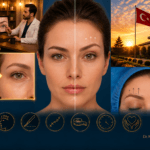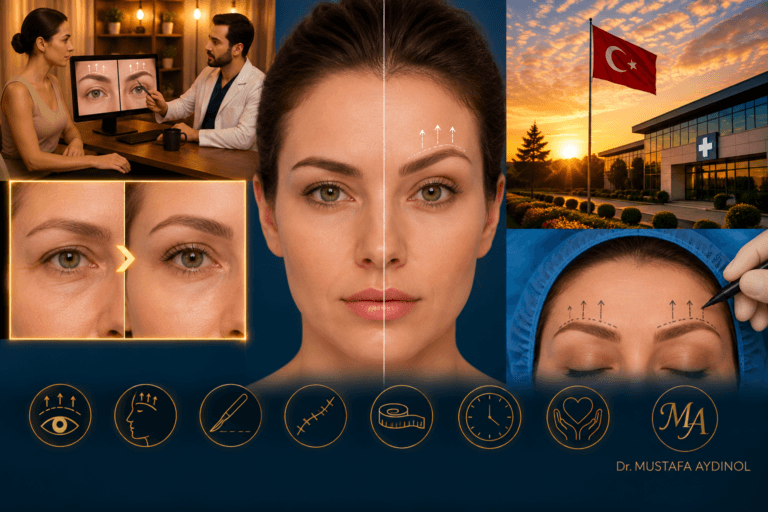


A high forehead is not a sign of aging and it is not a flaw, but for the patient who has spent years arranging a fringe over it, it is a daily preoccupation. Forehead reduction surgery, also called hairline lowering, moves the hairline down by two to three centimeters in one operation and hides the scar along the new hairline so that hair grows through it. It is a small operation with a large effect on facial proportion, and it is one of the procedures where choosing the right patient matters as much as the technique.
What Forehead Reduction Changes
The classic proportion divides the face into rough thirds: hairline to brow, brow to base of the nose, nose to chin. When the upper third is noticeably taller than the other two, the face reads as long and the eyes as low in it. Lowering the hairline restores the balance; it does not change the brow, the eyes or the nose, but each of them looks better placed once the forehead is shorter. Patients notice it most in photographs and in how they wear their hair, which many stop hiding behind for the first time in years.
The alternative is hair transplantation into the forehead, which builds a new hairline with grafts. It leaves no linear scar and can create a rounder, softer hairline shape, but it takes a year to grow in, the density is lower than native hair, and lowering more than a centimeter or two by grafts alone means thousands of grafts. Surgery moves the whole native hairline at once with its original density. In practice the choice is made by how much lowering is needed, by the mobility of the scalp, and by the stability of the patient’s hair, and the two approaches are sometimes combined: surgery for the bulk of the lowering, a small transplant later to round the corners or soften the scar.
Who Is a Good Candidate
The ideal candidate is a woman with a naturally high forehead, a stable hairline with no family history of pattern hair loss, and a scalp that moves freely when pushed forward. Scalp laxity is what sets the amount of lowering: a mobile scalp allows two to three centimeters in a single session, a tight one less. Greater lowering is possible with a tissue expander placed under the scalp for a few weeks before a second operation, but few patients need or want it.
Men can be candidates, and I operate on men whose forehead height is a lifelong feature rather than an early sign of hair loss. What I say to every male patient is this: if the hairline recedes in the years after surgery, the scar can become visible. That is not a reason to refuse the operation, because it has a solution; a hair transplant into the scar and the receded area covers it well. But it has to be said before surgery, not after. Men with active recession or a strong family history are usually better served by transplantation from the start.
The Operation
Forehead reduction is performed under general anesthesia and takes around two to three hours. The incision runs along the front edge of the hair, following its natural irregular line rather than a straight cut, and is angled so that the hair follicles at the edge are preserved and grow forward through the scar over the following months. The scalp behind the incision is loosened from the bone toward the crown, which is what allows it to advance, a strip of forehead skin matching the planned lowering is removed, and the scalp is drawn forward and fixed to the bone with small absorbable anchors so that the hairline does not drift back while it heals. The forehead skin is closed in two layers with attention to tension, because a scar under tension widens and a scar closed without tension stays fine.
The brow can be lifted through the same incision when the patient needs it, and a hairline brow lift is exactly that combination. You stay one night in hospital. There are no drains. Sutures along the hairline come out at about seven days.
Your Days in Istanbul
Day 0: surgery and one night in hospital. Days 1 to 4: at your hotel with a light head dressing for the first day or two; swelling moves into the forehead and upper eyelids and is at its peak on day two or three, then falls away. The scalp behind the incision feels numb and tight, which is expected. You wash your hair gently from day three. Day 5: final check, sutures out or a plan for removing them at home, and you fly. Five days in Istanbul is enough. Desk work is comfortable within a week, exercise at about three weeks. The scar is pink for the first months and fades over a year; fine hairs start to grow through it from about the third month, which is what makes it hard to find by the end of the first year.
The recovery planner shows these milestones as dates around your flight.
Risks and Honest Limits
The specific risks are a visible or widened scar, particularly if the hairline recedes later or the closure was under tension; numbness of the scalp behind the incision, which is usual for some months and occasionally lasting; temporary shedding of hair near the incision that regrows; and asymmetry of the new hairline that may need a small adjustment. Bleeding and infection are uncommon.
The limits are set by the scalp. Two to three centimeters is what one operation gives; a five-centimeter forehead does not become a two-centimeter one without an expander and two stages. The operation lowers the hairline but does not add hair, so a thin or fine frontal hairline stays thin, and a rounder or more feminine hairline shape may need grafts to complete. And a forehead that looks long because the brow is low is a brow problem, not a hairline problem; in that patient a brow lift is the right operation and lowering the hairline would make the face look heavier.
Smoking impairs healing at the hairline in particular; read what I ask of smokers before you book.
Cost of Forehead Reduction in Turkey
Forehead reduction in Istanbul costs considerably less than the same operation in the United Kingdom, Germany or the wider EU, and the difference comes from local operating costs rather than the technique. The figure depends on the amount of lowering, on whether a brow lift is added through the same incision, and on the operating and hospital time involved. I quote in writing after seeing photographs, and the quotation covers hospital, anesthesia and follow-up in Istanbul.
Send your photographs for an assessment: face straight to camera with the hair pulled back, a profile, and a close view of the hairline. Add whether anyone in your family has thinning hair. That is enough for me to tell you whether surgery, transplantation or a combination is the right route, and roughly how much lowering your scalp will allow. Message on WhatsApp: +90 544 772 0772.
Frequently Asked Questions
How much can the hairline be lowered?
Two to three centimeters in a single operation, set by how much your scalp moves. More is possible in two stages with a tissue expander.
Will the scar be visible?
The incision is placed along the hairline and angled so that hair grows through it. It is pink for a few months and hard to find by the end of the first year in most patients. It becomes visible only if the hairline later recedes, which is why male patients are counseled carefully.
Forehead reduction or hair transplant?
Surgery moves the whole hairline at once with native density and suits large corrections in a stable hairline. Transplantation leaves no linear scar and suits smaller corrections, men with any tendency to hair loss, and patients who want a rounder hairline shape. The two can be combined.
Can men have forehead reduction?
Yes, when the high forehead is a lifelong feature and the hairline is stable. If recession follows later, the scar can be covered with a hair transplant.
How long do I stay in Turkey?
Five days: one night in hospital, a check and suture removal around day five, then home.
Can a brow lift be done at the same time?
Yes. The hairline incision gives access to the forehead, and lifting the brow through it is a natural combination for a patient with a high forehead and heavy brows.
About the Surgeon
Dr Mustafa Aydınol is a plastic, reconstructive and aesthetic surgeon practising in Istanbul, a member of ISAPS and of the Turkish Society of Plastic Reconstructive and Aesthetic Surgeons. The practice holds Health Tourism Authorization from the Turkish Ministry of Health. Consultations are conducted in Turkish, English, German and Italian.