

Renuvion is a helium plasma device used under the skin to tighten tissue that has lost its elasticity. It is most often used alongside liposuction, in areas where fat removal alone would leave the skin looking loose. It is not a replacement for surgical skin removal, and the honest description of what it can and cannot do matters more than the marketing around it.
What Is Renuvion?
Renuvion, also known by its earlier name J-Plasma, is a device that combines radiofrequency energy with helium gas. The helium is converted into a cold plasma stream, and that plasma carries the radiofrequency energy to the tissue with far more precision than radiofrequency alone.
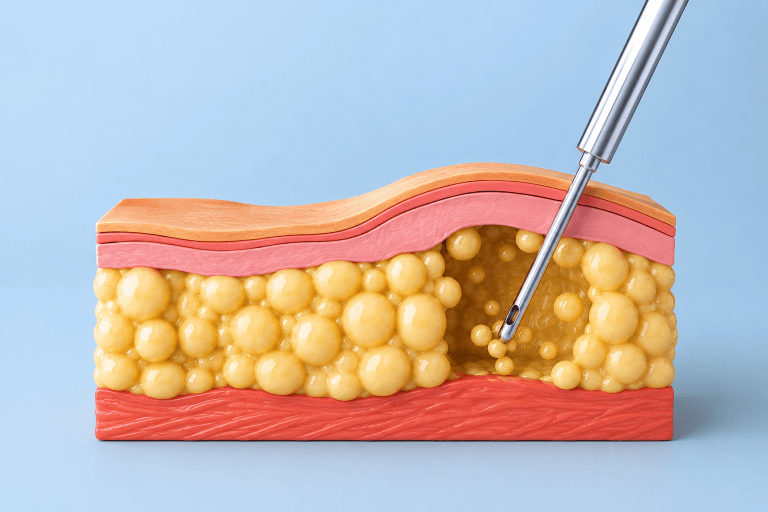
The handpiece is passed through small entry points beneath the skin, in the same plane where liposuction cannulas travel. It does not treat the skin surface, so it is not a resurfacing laser and it will not change pigmentation or fine surface lines.
How Helium Plasma Tightens Skin
The connective tissue layer under the skin is largely collagen. Collagen contracts when heated to a specific temperature range, and it continues to remodel for months afterwards as the body lays down new fibres.
Renuvion delivers energy in very short bursts. The plasma heats the tissue rapidly and then the helium cools it almost immediately, which allows the surgeon to reach the contraction temperature without holding heat in the tissue long enough to burn it. That heat and cool cycle is the reason the device can be used in a plane that sits directly under the skin.
Two things happen as a result:
- Immediate contraction. The collagen fibres shorten during treatment. Some tightening is visible on the table.
- Delayed remodelling. New collagen forms over the following months. The final result is usually judged at six months, not at six weeks.
What Renuvion Can and Cannot Do
This is the part most pages leave out, and it is the part that decides whether a patient is happy a year later.
Renuvion works well when
- Skin laxity is mild to moderate and the skin still has some spring to it
- The main problem is fat, and the skin needs support rather than removal
- The area is one where a scar would be difficult to hide: neck, jawline, upper arms, inner thighs, upper abdomen
- The patient is close to a stable weight
Renuvion is the wrong choice when
- There is a genuine skin excess that hangs, such as an apron of abdominal skin after major weight loss
- The abdominal muscles have separated after pregnancy, which no energy device can repair
- There are stretch marks across the area, since damaged skin does not contract the way healthy skin does
- Weight is still changing significantly
The simplest test: pinch the loose area and lift it. If releasing it leaves a fold that stays, the tissue needs to be removed surgically. If the skin snaps back but still looks soft over the fat underneath, that is the situation Renuvion was designed for.
Who Is a Good Candidate
In my practice the typical Renuvion patient falls into one of three groups.
Body contouring patients with good skin quality. Someone in their thirties or forties with localised fat and mild laxity, where VASER liposuction alone would produce a good but slightly soft result.
Patients after moderate weight loss. People who have lost weight steadily, including on GLP-1 medication, and who have laxity but not a true skin excess. Larger losses usually need surgical removal instead, or in addition.
Neck and jawline cases. The submental area responds well because the skin there is thin and the tissue plane is easy to treat evenly. For patients who are not yet ready for a facelift, this is often the honest middle option.
Renuvion with VASER Liposuction
I rarely use Renuvion on its own. The usual sequence in a body contouring case is VASER to emulsify the fat, MicroAire to remove it evenly, and Renuvion at the end to treat the undersurface of the skin across the whole treated area.
The logic is straightforward. Liposuction removes volume, which means the skin envelope that remains is now too large for what is underneath it. Treating that envelope in the same session addresses the problem before it becomes visible, rather than waiting to see whether the skin retracts on its own.
This also means Renuvion adds relatively little to the recovery. The compression garment, the swelling timeline and the return to activity are driven by the liposuction, not by the tightening. You can read the week by week course on the liposuction recovery timeline page.
Renuvion or a Tummy Tuck?
This is the question I am asked most often, and it deserves more space than a paragraph. The short answer is that they solve different problems: Renuvion tightens skin that is still capable of contracting, while a tummy tuck removes skin that is not, and repairs the muscle layer at the same time.
I have written a separate comparison, with a video explaining how I decide between the two in consultation: Renuvion vs tummy tuck.
The Procedure and Recovery
Renuvion is performed under general anaesthesia or sedation, depending on the extent of the area and whether it is combined with other procedures. Access is through the same small incisions used for liposuction, so there are no additional scars.
- First week. Swelling and bruising, at their peak around days three to five. Compression is worn continuously.
- Weeks two to four. Most patients are back to desk work within a week and to light exercise by the end of the first month.
- Months two to three. Swelling settles and the shape becomes recognisable.
- Months four to six. Collagen remodelling continues. This is when the tightening effect is properly assessed.
If you want a timeline built around your own surgery date, the recovery planner will generate one.
Risks and Side Effects
Renuvion is a heat based device used under the skin, and the risks follow from that. Burns and skin irregularity are the ones that matter, and both are related to technique: energy setting, speed of passage, and how evenly the surgeon treats the area. Numbness in the treated area is common early on and usually resolves. As with any procedure involving the subcutaneous plane, there is a small risk of seroma, infection and asymmetry.
Helium plasma devices also carry a specific consideration around gas accumulation in the tissue, which is why entry points are left open to allow it to escape. This is a surgeon technique issue rather than a patient decision, but it is worth knowing that it is a device with a real learning curve, not a plug and play add on.
Cost of Renuvion in Turkey
Renuvion is almost never priced as a standalone item, because it is almost never performed as a standalone procedure. The cost depends on how many areas are treated, whether it is combined with liposuction or a lift, the length of the operation, and the anaesthesia required.
What I can say plainly is that treatment in Istanbul is substantially less expensive than the equivalent operation in Western Europe or the United Kingdom, and that the difference comes from local operating and staffing costs rather than from any difference in the device or the implants used. I give a written quotation after reviewing photographs and medical history, not before.
Send your photographs for an assessment. I review every case personally and tell you honestly whether Renuvion is enough, or whether you need skin removal instead. info@mustafaaydinol.com
Frequently Asked Questions
What is Renuvion used for?
It is used to tighten loose skin from underneath, most commonly on the abdomen, flanks, upper arms, inner thighs, neck and jawline, usually in the same session as liposuction.
How does the Renuvion device work?
It converts helium gas into a cold plasma that carries radiofrequency energy to the tissue. The tissue heats rapidly, the collagen contracts, and the helium cools the area immediately afterwards, which limits heat spread.
Is Renuvion permanent?
The collagen contraction is lasting, but it does not stop the skin from ageing. Weight gain, pregnancy and time will continue to affect the result as they would after any procedure.
How long does it take to see results?
Some tightening is visible immediately, but swelling masks it for the first few weeks. The honest assessment point is around six months.
Is Renuvion better than a surgical lift?
Not better, different. A lift removes tissue and leaves a scar. Renuvion tightens tissue without a scar but cannot remove anything. If there is real excess, a lift is the correct operation and Renuvion is not a substitute for it.
Can Renuvion be done without liposuction?
It can, in areas where laxity is the only problem and there is little fat, such as the neck. In most body cases the two are done together.
About the Surgeon
Dr Mustafa Aydınol is a plastic, reconstructive and aesthetic surgeon practising in Istanbul, a member of ISAPS and of the Turkish Society of Plastic Reconstructive and Aesthetic Surgeons. The practice holds Health Tourism Authorization from the Turkish Ministry of Health.