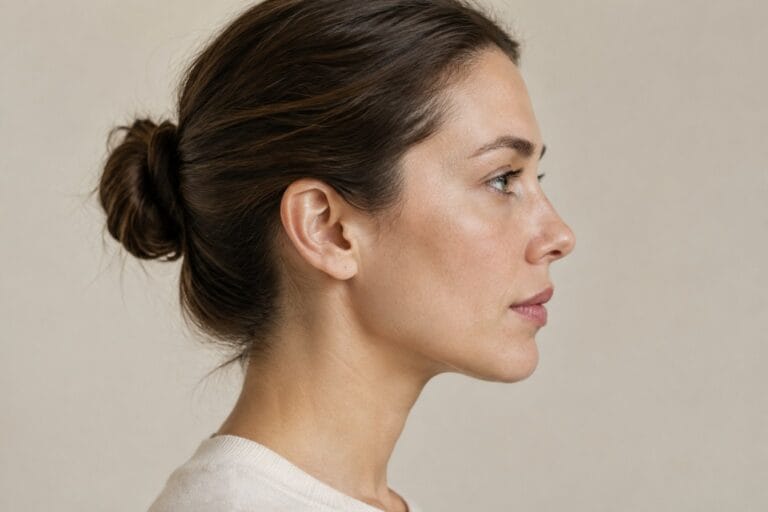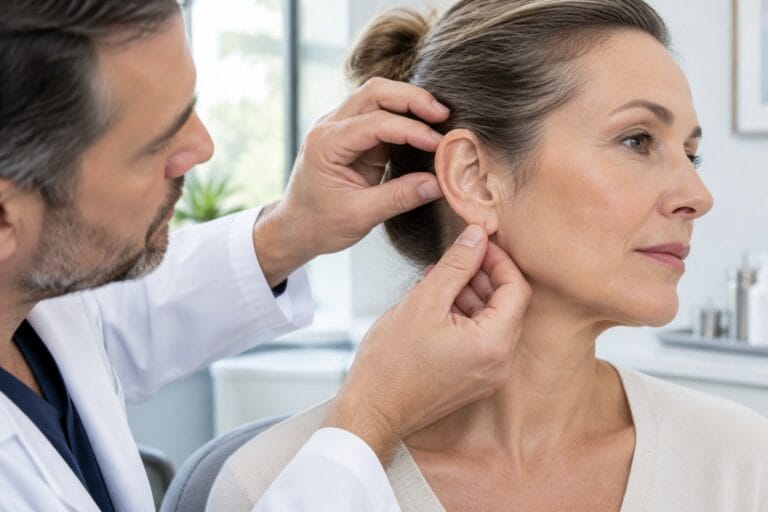


A soft hump at the base of the back of the neck is one of the body contouring problems patients are most embarrassed to ask about. They hide it under hair, collars and scarves, and they often assume it is a posture problem or a bone that has grown. In most of the patients I see, it is neither. It is a pad of fat, often mixed with dense fibrous tissue, sitting on top of the spine where the neck meets the upper back, and it can be removed.
This page explains what a buffalo hump is and what it is not, why it forms, when it should be checked by a doctor before anyone talks about surgery, what does and does not remove it, and how I treat it: with liposuction when the hump is mostly soft fat, and by removing it through an incision when it is firm and fibrous or contains a lipoma.
What a Buffalo Hump Is, and What It Is Not
The medical name is a dorsocervical fat pad: a collection of fat over the lowest bones of the neck and the top of the upper back. Patients search for it under several names, and they do not all mean the same thing:
- Buffalo hump, neck hump, hump on the back of the neck. A soft or rubbery swelling that sits on top of the spine and moves with the skin. You can pinch it, and it does not change when you straighten up. This is the problem this page is about.
- Dowager’s hump. A forward curve of the upper spine itself, called kyphosis, usually from posture, age or weakened vertebrae. The bones are bent, so there is nothing to pinch, and it improves at least partly when you stand straight. It is a matter for a physiotherapist or a spine doctor, not for a plastic surgeon. Some people have both: a curved spine with a fat pad on top of it.
- Lipoma. A single, well-defined fatty lump with its own thin capsule. It can sit in the same place and look like a buffalo hump, and it is also removed through an incision.
The distinction matters because each one needs a different plan, and a photograph alone does not always separate them. In a 2026 study of 383 patients operated on for a buffalo hump and classified with MRI, about three quarters had a true fat pad, about one in ten had a more diffuse fat accumulation, about one in ten turned out to have a lipoma, and a small number had a mix.
Why It Forms
In most patients there is no single cause. The fat pad grows slowly with weight gain and age, and it is common in people who otherwise carry little fat; many patients notice it after their forties. The tissue in this area is unusual: the fat is held in a dense network of fibrous strands, which is why a buffalo hump feels firmer than fat elsewhere and why it does not shrink much with diet.
A smaller group of patients has a medical reason, and those are the ones that should be found before surgery:
- Too much cortisol. Cushing’s syndrome, a rare hormonal condition, typically produces a fat pad at the back of the neck together with a rounder face, weight gain around the trunk, thin skin that bruises easily, wide purple stretch marks, high blood pressure or raised blood sugar.
- Long-term steroid medication. Steroid tablets or injections taken for months, for asthma, arthritis or another condition, can cause the same pattern.
- Other conditions and medications that change how the body stores fat, which your own doctor will know about from your history.
When to See a Doctor First
Before any discussion of surgery, I ask about the signs above. If the hump appeared quickly, if it came with a rounder face, easy bruising, purple stretch marks, muscle weakness, high blood pressure or high blood sugar, or if you take steroid medication, a cortisol test may be needed first. Treating the cause can shrink the fat pad, and removing it without treating the cause risks it coming back.
A lump that is hard, fixed to the tissue underneath, painful, or growing month by month also needs to be examined first, and an ultrasound may be requested, because not every lump in this area is fat. In practice, most patients I see have none of these signs, and their hump is the ordinary, slowly grown fat pad.
What Does Not Remove It
Posture exercises are useful for a dowager’s hump and for neck pain, and they make the whole area look better when the shoulders roll back, but they do not remove fat. Weight loss reduces a buffalo hump less than it reduces fat elsewhere, because of the fibrous tissue that holds it. Massage, cupping and acupuncture have been reported to reduce the size of the pad in small case series, without controlled comparisons or long follow-up. Fat-dissolving injections have been tried in case reports; with the fibrous tissue and the volume involved, they are not a practical alternative to surgery for most patients.
Excision or Liposuction: How the Decision Is Made
The fibrous tissue is what decides the method. An ultrasound study that compared the scan with the tissue under the microscope found three types of buffalo hump: mostly fat, mixed, and mostly fibrous. The mostly fat type can be treated with liposuction; the mostly fibrous type needs the tissue to be cut out. A small series of ultrasound-assisted liposuction showed the same problem from the other side: dense fibrous strands and tethering to the deeper layer left some fullness in one of five patients, even with an adequate volume removed.
Liposuction for a hump that is mostly soft fat. Liposuction is the most commonly reported treatment for a buffalo hump, and a meta-analysis of 22 studies and 218 patients found it safe and effective. It works through two or three small incisions, so there is no long scar. The pooled recurrence rate after liposuction was 10.6 percent and the revision rate 15.3 percent, but when the studies that drove most of that variation were set aside, they fell to 1.4 and 1.3 percent. Techniques that break up the fibrous network during suction have widened the range of humps it can treat; in one 2026 series of 30 patients with fibrous humps, an average of 260.7 milliliters was removed, two independent surgeons rated 93.3 percent of results good or excellent at one year, and 80 percent of patients were satisfied. My page on liposuction in Turkey covers the operation and the other areas it treats.
Excision for a firm, fibrous hump or a lipoma. When the hump is dense and fibrous, or when there is a lipoma inside it, I remove the tissue through an incision. In the same meta-analysis, there was no recurrence after the fat pad was cut out. The price is a longer scar and a higher rate of wound problems, such as a fluid collection or slow healing.
How the choice is made. The examination usually tells: a hump that pinches like soft fat suits liposuction, and one that feels firm and rubbery, or contains a distinct lump, suits excision. When it is unclear, an ultrasound shows how much of the tissue is fibrous. Your own priorities count too: liposuction avoids a longer scar with a higher chance that some fullness remains, and excision gives the most complete result at the cost of a scar. We decide together, and if liposuction of other areas is already planned, the hump is treated in the same session.
The Operation as I Perform It
I mark the hump with you standing, because its edges are easiest to see then, and the operation is done lying face down.
Liposuction. I use VASER and the power-assisted MicroAire cannula through two or three small incisions, hidden at the hairline or in a skin crease where possible, and the dense, fibrous tissue of the back of the neck is exactly where the power-assisted cannula earns its place. The fat is removed from the center of the hump outward and tapered into the surrounding neck and upper back so that no step or hollow is left. As with all my liposuction, you stay one night in the hospital.
Excision. Under local anesthesia when the hump is not very large, otherwise under general anesthesia. Through an incision over the area, I remove the fibrous fat pad, together with any lipoma inside it, leaving a smooth layer of fat under the skin so that no hollow is left, and tapering the edges into the surrounding neck and upper back. Where the skin has been stretched by a large pad, some of it can be removed through the same incision. Where the scar sits and how long it is depends on the size and shape of the hump and on whether skin is removed, and we plan it together at the examination. A drain is placed when it is needed, and the skin is closed in layers.
Combining It With Other Operations
A buffalo hump rarely comes alone, and it combines well with the operations around it:
- Double chin liposuction. Fat under the chin and fat at the back of the neck often appear together; both are treated in the same session. The front of the neck is covered on my page on double chin liposuction.
- Liposuction of the upper back, bra line and flanks. The hump often continues into the upper back, and the bra line and love handles are frequently treated at the same time, in the same session as the hump.
- Arms. Upper arm liposuction or, for loose skin, an arm lift.
- Loose skin. Skin tightening is rarely needed at the back of the neck, and when it is, Renuvion or Endolift can be added in the same session. If the skin of the back is clearly loose further down, a back lift is a separate conversation.
The combination planner shows which operations I plan together and in what order.
Your Week in Istanbul
- Before you travel: you send photographs of the back of your neck from behind and from the side, with your hair tied up, and tell me how long the hump has been there and whether you take any regular medication. I tell you whether it looks like a fat pad, whether anything should be checked first, and what else is worth treating.
- Day 0: examination and markings, the day before surgery when your arrival allows, otherwise on the morning of the operation. If anything in the examination suggests a lipoma or another kind of lump, an ultrasound can be requested before surgery.
- Surgery day: in the hospital, whether the hump is removed under local or general anesthesia; after liposuction, you stay one night.
- The following days: check-ups at the clinic, a change of dressing, and removal of the drain if one was placed.
- Flying home: usually on day five or six; the plan changes when the hump is treated together with other operations.
Recovery
The area is swollen, bruised and sore for the first week, and lying on your back is uncomfortable for a few nights, so most patients sleep on their side or slightly propped up. The skin over the area is often numb for several weeks. After an excision, bending the neck far forward pulls on the incision in the first weeks, so desk work with the screen at eye level is easier than looking down at a phone or a laptop. Most patients return to desk work after about a week and to full training at about six weeks. After liposuction, you wear a compression garment day and night for the first three weeks, then at night until six to eight weeks. The contour looks better as soon as the swelling goes down and is final at about three months; the scar keeps fading for about a year.
Risks and Honest Limits
Numbness and fluid collections are the most common problems. In the 383-patient series, numbness of the skin over the area occurred in 14.36 percent, a fluid collection under the skin in 6.27 percent, a thickened scar in 2.09 percent and a blood collection in 0.78 percent. The numbness usually improves over months, and a fluid collection is drained at a check-up.
After liposuction, some fullness can remain. Where the tissue turns out to be more fibrous than expected, suction can leave a small residual bump, and a second, smaller procedure may be needed. I would rather tell you this before the operation than promise a flat line that the tissue cannot give.
After excision, the scar is the price of a complete result. The back of the neck is under tension every time you bend your head, so a scar here can widen or thicken. Scar care in the first months helps, and a thickened scar can be treated; my page on scar revision explains how.
It can come back. Recurrence after excision is rare, and after careful liposuction it is low, but it is more likely if you gain weight, and if there is an untreated hormonal cause or ongoing steroid medication, the fat pad can return.
What surgery cannot do. Removing the fat pad does not straighten a curved spine, so if part of what you see is a dowager’s hump, that part remains. Like any surgery, it can also bring infection, slow wound healing, an irregular contour or a result that is not quite symmetrical. Unless there is an urgent reason, any revision waits six to twelve months after the first operation.
What Shapes the Price and What Is Included
- The size and type of the hump, and whether it is removed through an incision or with liposuction.
- Whether a lipoma or excess skin is removed as well.
- Other areas treated in the same session, such as the chin, the upper back, the flanks or the arms.
- First operation or revision of a hump treated elsewhere.
Every quotation is all inclusive: the surgery, the hospital, the anesthesia, medication, your accommodation, airport and clinic transfers, and the follow-up visits in Istanbul. If you prefer to arrange your own hotel and travel, that is possible too. More about how the week is organized is on my page on plastic surgery in Turkey.
Before and After: How to Read the Photographs
A buffalo hump is judged from the side, so the photograph that matters is the side view, with the head held level, the shoulders relaxed and the hair tied up. A head bent forward makes any hump look bigger, and a head tilted back hides it, which is how many dramatic before and after pairs are made. Look for the same angle and posture, and for a photograph taken at least three months after surgery. My cases are in the before and after gallery, and I show more in a video consultation.
Send your photographs for an assessment. One photograph of the back of your neck from behind and one from each side, in daylight, with your hair tied up, your head level and your shoulders relaxed, plus your age, how long the hump has been there, and any regular medication you take. I will tell you whether it looks like a fat pad, how it is best removed, whether anything should be checked first, and what else is worth considering, usually the same day. Send them on WhatsApp, +90 544 772 0772, or by email, info@mustafaaydinol.com, whichever you prefer.
Frequently Asked Questions
Is a buffalo hump the same as a dowager’s hump?
No. A buffalo hump is a pad of fat on top of the spine that you can pinch; a dowager’s hump is a curve of the spine itself. A fat pad can be removed surgically, while a curved spine is treated with posture work and, when needed, by a spine doctor. Some people have both.
Can a buffalo hump go away with exercise or weight loss?
Not usually. Posture exercises make the area look better and help with neck pain, and weight loss can reduce the hump a little, but the fibrous tissue that holds the fat makes it one of the most resistant fat deposits in the body.
Is a buffalo hump a sign of a medical problem?
Most of the time it is not. It can be a sign of too much cortisol, from Cushing’s syndrome or from long-term steroid medication, especially when it comes with a rounder face, easy bruising, purple stretch marks or high blood pressure. In that case a cortisol test comes before any talk of surgery.
Is a buffalo hump removed with liposuction or surgery?
Both are used, and the tissue decides. A hump that is mostly soft fat is treated with liposuction through small incisions; a firm, fibrous hump or one that contains a lipoma is removed through an incision. The examination, and an ultrasound when needed, tells which one you have.
Will the hump come back?
Recurrence after excision is rare in the published studies, and low after careful liposuction. It is more likely with weight gain or an untreated hormonal cause.
Will there be a scar?
Liposuction leaves two or three scars a few millimeters long, placed at the hairline or in a crease where possible. An excision leaves a longer scar; its position and length depend on the size of the hump and on whether skin is removed, and we plan it together at the examination.
About the Surgeon
Dr. Mustafa Aydınol is a plastic, reconstructive and aesthetic surgeon practicing in Istanbul, a member of ISAPS and of the Turkish Society of Plastic Reconstructive and Aesthetic Surgeons. The practice holds Health Tourism Authorization from the Turkish Ministry of Health.
Sources
- Li FW, Wu Y, Liao ZF, et al. Clinical classification of buffalo hump based on appearance and MRI: a retrospective study of 383 cases. Type I dorsocervical fat pad 77.57 percent, type II diffuse fat accumulation 11.23 percent, type III lipoma 10.18 percent, type IV mixed 1.04 percent; no recurrence after surgery; numbness 14.36 percent, seroma 6.27 percent, hypertrophic scar 2.09 percent, hematoma 0.78 percent. Aesthetic Plastic Surgery, 2026. DOI
- Escandón JM, Matsui C, De La Cruz Ku G, Escandón L, Ciudad P, Manrique OJ. Surgical management of dorsocervical fibro-lipodystrophy (buffalo hump): systematic review and meta-analysis. 22 studies, 218 patients; recurrence 10.6 percent and revision 15.3 percent after liposuction, 1.4 and 1.3 percent after sensitivity analysis; 0 percent recurrence after excision, with more wound complications. Aesthetic Plastic Surgery, 2026. DOI
- Ding A, Wang Q, Lyu D, Xiong P, Zhou R. A pathologically validated B-mode ultrasound classification system for surgical planning in dorsocervical fibrofatty humps. 86 patients; adipose-dominant, mixed and fibrous-dominant subtypes; ultrasound accuracy 92 to 93 percent; adipose-dominant lesions suited to liposuction, fibrous-dominant lesions to excision or limited open approaches. Aesthetic Plastic Surgery, 2026. DOI
- Kim J, Kim Y, Rha E, Shin J. Ultrasound-assisted liposuction for idiopathic buffalo hump: anatomical considerations and technical implications. 5 patients, mean lipoaspirate 178 milliliters; one patient with residual prominence attributed to dense fibrous septa and fascial tethering. Journal of Clinical Medicine, 2026. DOI
- Wang Y, Guo K, Zhuang ZM, et al. Continuous release-assisted sharp-tip aspiration for fibrotic dorsocervical fat pads: a phase-adapted cannula protocol. 30 patients, mean 260.7 milliliters removed; 93.3 percent good or excellent at 12 months by two independent raters; 80 percent satisfied; no major complications or revisions. Aesthetic Plastic Surgery, 2026. DOI
- Wang Q, Zhang L, Emu J, et al. Standardized three-step ultrasound-assisted liposuction for dorsocervical fat pad: efficacy and safety analysis. 48 patients, mean aspirate 326.4 milliliters; satisfaction 95.83 percent; 4 minor complications; no recurrence at 6 to 12 months. Journal of Craniofacial Surgery, 2026. DOI
- Ceccato F, Boscaro M. Cushing’s syndrome: screening and diagnosis. Lists the dorsocervical fat pad among the typical features of Cushing’s syndrome, with hypertension, diabetes, facial rounding, thin skin and purple striae, and reviews the screening tests. High Blood Pressure and Cardiovascular Prevention, 2016. DOI