

What happened
On 11 November the New York Times asked “Should I have eyelid surgery?” and reported that patients under 35 are now the fastest-growing group asking for it. A few days earlier Katie Ginella, 42, a former reality television cast member, filmed herself the morning after upper and lower eyelid surgery and said her phone’s face recognition no longer knew her. And the ISAPS global survey published in September counted 2.46 million eyelid operations in 2025, up 16 percent, more than any other operation in the world.
The American figures behind the headline are worth reading slowly. Plastic surgeons there performed 118,978 eyelid operations in 2025, up 19 percent. In patients aged 18 to 25 the number rose 54 percent, to 366. In patients aged 26 to 35 it rose 34 percent, to 2,676. So the fastest-growing group is also the smallest: about 3,000 operations, under 3 percent of the total, while more than two thirds were in patients aged 56 and over. In the same year total cosmetic surgery fell 9 percent in the 18 to 25 group and 5 percent in the 26 to 35 group. Young adults are having less surgery overall and more eyelid surgery. That needs an explanation, and a caution.
The common misconception
The misconception behind most requests for hooded eyelid surgery is that a hooded eyelid is extra skin, and extra skin is cut away. At 60 that is often true. At 28 it rarely is. A young hooded eyelid is usually one of three other things, and for two of them removing skin is the wrong operation. The second misconception follows from the first: because the operation is small and the recovery short, the decision must be small too. It is not. Eyelid skin that has been removed does not come back, and a 28-year-old will live with that lid for fifty years.
The clinical reality
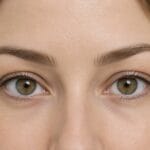
A hooded eyelid at 25 is usually the eyelid you were born with. A low brow, a low crease and a full upper lid run in families. Look at a photograph of yourself at 18 and at your parents’ eyes: if the fold was there then, nothing has gone wrong. This is a shape, not a defect. Surgery can change a shape, and I do, but then it is a design decision made with the patient, not the repair of something that failed.
Sometimes the lid is fine and the brow is low. When the brow sits low, it rests on the lid and the lid looks heavy. Cutting lid skin treats the wrong structure, and it can make the brow problem worse: a meta-analysis of upper eyelid surgery found that brow height falls afterward by 1.45 millimeters on average, and by 0.67 millimeters after a simple skin operation. Many of these patients have been lifting their brows all day to open their eyes without knowing it; once the lid is lighter the habit relaxes, the brow settles, and some of the hooding returns. In this patient I lift the brow, usually the outer part through the temple with an endoscope, and leave the lid alone or take very little. Wrinkle-relaxing injections do nothing for a dropped brow, and threads do not last. The options are on my page about brow lift surgery.
Sometimes the lid itself hangs low, and that is a muscle problem. It is called ptosis: the edge of the lid sits too far down over the eye because the muscle that raises it is weak or its attachment has stretched. In a study of 2,530 people who came for upper eyelid surgery, 13.7 percent had ptosis nobody had diagnosed, most of it mild, and uneven eyebrows were the clue: ptosis was found in 75 percent of patients with brow asymmetry against 4 percent without. In young adults contact lenses are a recognized cause; a study of 96 pairs of identical twins found more droop in the twins who wore lenses than in their siblings who did not, and more with hard lenses than with soft. Removing skin from a ptotic lid does not raise it. It uncovers it. I repair ptosis myself, and when a lid is both droopy and heavy with skin I correct both in the same operation.
And sometimes it really is skin. Some families pass down true excess skin early. Weight loss, allergy and years of rubbing can stretch a lid before 30. If a patient under 30 has a genuine need, I operate; age is not the criterion, the eyelid is. What changes at that age is how much I take. I remove less skin, leave the muscle and keep the fat, because a hollow upper lid ages a face faster than a full one. A meta-analysis of 12 randomized trials found that removing muscle along with skin gave no gain in satisfaction and raised the odds of incomplete eye closure about eightfold.
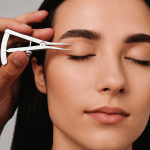
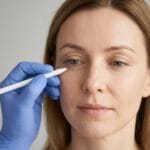
The assessment decides, and sometimes it decides no. How a patient looks today is the best and most vivid evidence there is, and in most cases good photographs show me which of the four I am looking at. Some cases sit between two answers. For those I ask for a video call, or for a consultation in person, depending on the situation. After that assessment I may decline. I decline when the lid is normal and the reference is a filtered image, a problem I have described in my article on the AI face. I decline when the problem is the brow and the patient will accept only lid surgery.
Recovery is short, and the first week is not the result. Ginella’s phone was right for about two weeks: swelling changes the geometry of the eye until it settles. Upper eyelid surgery alone is usually a day case. The stitches come out between day five and day seven, most patients are back at a desk in seven to ten days, and swimming waits three to four weeks. The details are in my eyelid surgery guide and on the page about blepharoplasty in Turkey.
The practical takeaway for patients
Send four photographs taken in daylight with the forehead relaxed: eyes open looking straight ahead, eyes closed, looking up, and one from each side. Recent photographs are what matter; how you look today is what I assess. If they leave the answer open, I will ask for a video call or a consultation in person.
Tell me whether you wear contact lenses and for how many years, whether one eye has always looked smaller, whether the lids feel heavier in the evening, and whether people tell you that you raise your eyebrows when you talk.
Ask which of the four it is in your case: inherited shape, brow, muscle or skin. The answer tells you which operation, if any, you are actually discussing.
If you are under 30 and the answer is no, ask why. A good no comes with a reason and usually with an alternative.
Honest limits
The age figures are American and describe board-certified plastic surgeons only. The ptosis study was done in one center and its ptotic patients were older than the rest, so 13.7 percent is not the rate in a 25-year-old. The twin study shows an association, and the differences were fractions of a millimeter. The brow meta-analysis mixes several operations and populations, and the eightfold figure for eye closure comes with a wide margin of error. My statement that a young hooded eyelid is usually inherited anatomy comes from my own consultations, not from a trial. And a recovery video is one person’s first morning, not a result; I have not commented on hers.
If you are wondering whether your eyelids are a skin problem, a brow problem or a muscle problem, and whether hooded eyelid surgery is the answer at all, send the photographs described above to +90 544 772 0772. The surgical team reviews them the same day.
Dr. Mustafa Aydınol is a plastic, reconstructive and aesthetic surgeon in Istanbul and a member of ISAPS.
Sources
- The New York Times, 11 November 2026: Should I have eyelid surgery? Link
- The Daily Beast, 9 November 2026: reality star reveals unusual side effect of eyelid surgery. Link
- American Society of Plastic Surgeons. 2025 Plastic Surgery Statistics Report: eyelid surgery 118,978 procedures, up 19 percent; age distribution tables, 18 to 25 and 26 to 35. Link
- International Society of Aesthetic Plastic Surgery. ISAPS International Survey on Aesthetic/Cosmetic Procedures Performed in 2025: eyelid surgery 2,457,677 procedures, up 16.2 percent. Link
- Eshraghi B, Pourazizi M, Taghian A, Chaibakhsh S, Aghajani A. The prevalence of undiagnosed ptosis among candidates for upper eyelid blepharoplasty: 2,530 candidates, 13.7 percent with undiagnosed ptosis. Aesthet Surg J Open Forum, 2023. DOI
- Liu R, Sun Y, Huang J, Long X. Brow position change and its potential risk factors following upper blepharoplasty: a systematic review and meta-analysis, 17 studies, mean brow descent 1.45 mm. Aesthetic Plast Surg, 2023. DOI
- Satariano N, Brown MS, Zwiebel S, Guyuron B. Environmental factors that contribute to upper eyelid ptosis: a study of identical twins, 96 pairs, contact lens wear associated with ptosis. Aesthet Surg J, 2015. DOI
- Todorov D, Mitchell S, Al-Hashimi M, et al. Functional and aesthetic outcomes after upper blepharoplasty: a systematic review and meta-analysis of randomized control trials, 12 trials, 450 patients. Aesthet Surg J, 2025. DOI