

What happened
This week British television and newspapers picked up something surgeons have been quietly dealing with all year: patients arriving at consultations with AI-generated pictures of themselves. Some asked a chatbot which procedures they should have. Others asked it to draw their face after the surgery they were planning, and brought the result in as the goal. The trend already has a name, the “AI face”: poreless skin, a razor-sharp jaw, oversized eyes, near-perfect symmetry. One London surgeon told reporters that colleagues are inundated with these images. A US hospital survey found that patients who used AI to enhance their photos came in with significantly higher expectations for surgery.
My consultations begin with photographs sent over WhatsApp, so this trend lands directly on my desk. Here is my honest position on it.
The common misconception
The misconception is that an AI image of your face is a preview. It is not. It is a drawing. A very persuasive drawing, generated by a system that has never touched a face and does not know that yours contains bone, cartilage, blood supply, nerve branches and skin of a particular thickness that will heal in its own particular way.
AI controls every pixel. Surgery does not work at the pixel level. It works at the level of tissue, and tissue has rules.
The clinical reality
The image skips the part that is actually surgery. When an AI slims a nose, it does not decide what happens to your breathing. When it sharpens a jawline, it does not account for where your facial nerve runs. When it erases pores and folds, it is not tightening skin; it is deleting texture, which no operation does. I have seen requested noses that would not pass air and waistlines that would leave no room for the organs. The picture is pretty because nothing in it had to survive.
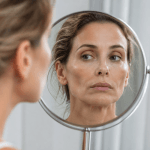
The image gets wired in. This is the part I take most seriously. According to research on filtered self-images, once a person repeatedly sees an idealised version of their own face, that version starts to feel like the real one, and the mirror starts to feel like the error. Dermatologists described this in 2018 as a driver of body dysmorphic disorder in the filter era, and a 2024 survey of 1,483 adults found body dysmorphic symptoms in about a quarter of respondents, with heavy social media use and higher acceptance of cosmetic surgery going together. AI images are stronger than filters: they are unlimited, personalised and free. If looking at your generated face has become a daily habit, that is worth telling your surgeon honestly, because it changes what a good consultation looks like.
The unfiltered photo is your friend, not your enemy. A 2021 study took the same four people and photographed them four ways: selfie, filtered selfie, phone camera, and a standard clinical camera. Then 240 strangers rated first impressions. The clinical photograph, the one everyone dreads, scored highest. The face you are trying to fix in the front camera is partly an artefact of the front camera.
The practical takeaway for patients
When you write to me, send real photographs: daylight from a window, no beauty mode, no filter, both sides and front, taken by someone else or with the rear camera at arm’s length. I plan on your anatomy, not on your phone’s opinion of you.
Reference images are welcome, including AI ones, if we use them correctly. A reference tells me the direction you like: softer, sharper, more rested. It is a compass, not a contract. The moment a reference becomes “make me exactly this”, the consultation has to slow down, because exactly-this does not exist in tissue.
And ask any surgeon you consult one question: “What will this look like on my face, with my skin, at one year?” A surgeon who answers with your anatomy is planning surgery. A surgeon who answers with the picture is selling it. The rest of the vetting checklist applies unchanged.
Honest limits
I am not against technology in planning. Imaging and simulation, used by the surgeon in the room, can be honest tools; they help us agree on direction. The difference is that a responsible simulation is constrained by your anatomy and comes with the sentence “this is an estimate”, while a chatbot image is constrained by nothing and comes with confidence.
I also will not pretend every AI-assisted patient is dysmorphic. Most are simply doing their homework with the tools of 2026, the way patients once brought magazine pages. The homework is welcome. My job is to translate it into what your face can actually do, and sometimes my honest translation is “this image is not you, and chasing it will not make you happier”. I have said the same thing about ordering another woman’s breasts; the principle does not change when the woman is generated.
If you are considering something and want an opinion based on your real face, send unedited photos to +90 544 772 0772. Send the AI image too if you have one. I will tell you which parts of it are a direction and which parts are a drawing.
Dr. Mustafa Aydınol is a plastic, reconstructive and aesthetic surgeon in Istanbul and a member of ISAPS.
Sources
- Rajanala S, Maymone MBC, Vashi NA. Selfies, living in the era of filtered photographs. JAMA Facial Plast Surg, 2018. DOI
- Ateq K, Alhajji M, Alhusseini N. Social media use, body dysmorphic disorder and attitudes toward cosmetic surgery, survey of 1,483 adults. Front Public Health, 2024. DOI
- Cristel RT et al. Evaluation of selfies and filtered selfies and effects on first impressions, 240 evaluators. Aesthet Surg J, 2021. DOI
- Silence C, Rice SM, Kourosh AS. Our post-Zoom reflection: turning off the monitor. Facial Plast Surg Aesthet Med, 2022. DOI
- Added after publication: Li C. AI face drives patients to plastic surgery, news report on the BAAPS warning. BMJ, volume 394, 8 September 2026. DOI