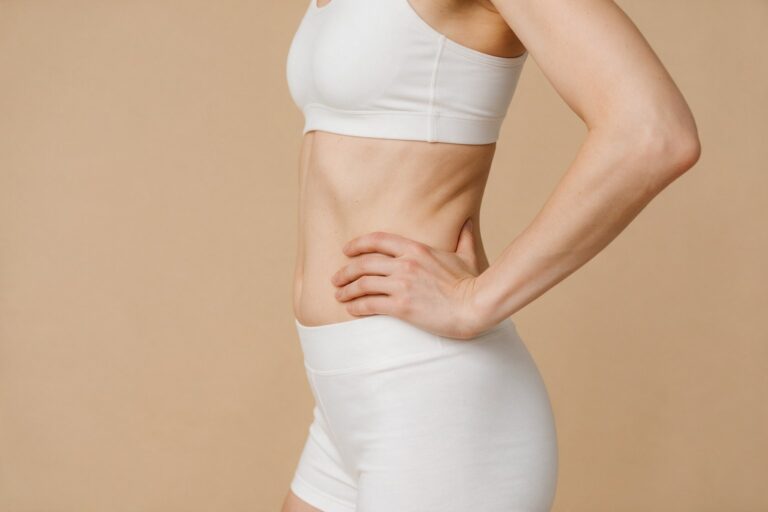


A C-section shelf is the fold of skin and fat that sits above a cesarean scar and hangs over it, so that the lower abdomen looks like a step when you stand and a pouch when you sit. It is one of the most common reasons women write to me after pregnancy, and many of them have been told it is simply fat that more exercise will remove. Usually it is not.
The shelf has three parts: a scar that has healed tethered to the deeper layers, skin and fat that have stretched above it, and, in many women, abdominal muscles that pregnancy has pulled apart. Exercise works on only one of them. This page explains why the shelf forms, what exercise and a garment can do, and which operation corrects which shelf.
C-Section Shelf, C-Section Pouch, Overhang: What It Is and What It Is Not
Women describe the same lower abdomen in different words. What each one means:
- C-section shelf. The step formed where the skin and fat above a cesarean scar overhang the scar, while the scar stays pulled inward.
- C-section pouch, mommy pouch. The same area seen from the side or when sitting: a soft bulge below the navel, made of fat and skin, a muscle separation behind it, or both.
- C-section overhang, cesarean apron. A larger fold that hangs over the scar and sometimes over the pubic area.
- Diastasis recti. The gap between the two vertical abdominal muscles after pregnancy. It is a muscle problem, not a fat problem, and it makes the abdomen push forward even in slim women.
- Scar tethering. The cesarean scar heals attached to the deeper tissue, like a seam pulled inward, and the tissue above it folds over it.
In German the same shelf is called Kaiserschnitt-Bauch, in Turkish sezaryen göbeği. It is not a sign that the cesarean was done badly, and it is not a hernia. A hernia is a weakness in the muscle wall that lets tissue from inside the abdomen push through; it is checked for separately and, when present, repaired in the same operation.
Why the Shelf Forms
The shelf appears after uncomplicated cesareans, in slim women as well as in women who are overweight, and it often stays after weight loss. A 2026 review in an obstetrics journal described it as a frequent but often overlooked deformity and proposed an explanation: during a cesarean, a membranous layer inside the fat of the lower abdomen (the Scarpa fascia) is often left open. Its edges retract, the deeper fat pushes forward into the gap, and as the wound heals the scar is pulled inward. This is a proposed mechanism, not a proven one, but it matches what I see in surgery: the scar is tethered to the deeper layers, with a cushion of fat above it.
Its size depends on the scar, the stretched skin and fat above it, and whether separated muscles push the lower abdomen forward from behind. The same review graded the deformity in four steps, from a mild bulge above the scar to a large apron reaching the pubic area, and each step needs a different operation.
What Helps Without Surgery, and When Surgery Makes Sense
Time. The abdominal wall and the skin keep recovering for many months after the birth, and part of the early bulge settles on its own. This is why I do not plan surgery in the first six months to a year.
Weight. Losing excess weight shrinks the fat cushion above the scar. It does not release the scar or tighten skin that has stretched beyond its ability to recover.
Exercise. Exercise is good for you after pregnancy, but it does not reliably close a muscle separation. In a randomized trial of 175 first-time mothers, four months of supervised training starting six weeks after birth did not reduce how many women had a separation at six or twelve months. A 2026 trial of hypopressive training found the same: abdominal function and body image improved, the gap did not. In a 2026 cohort, about 30 percent of first-time mothers still had a separation wider than 3 centimeters one year after birth. And no exercise reaches a scar tethered to the deeper layers, which is why women who train hard can still have a shelf.
A postpartum binder or girdle. The randomized trials of abdominal binders after a cesarean measured pain, distress and walking in the first days, with mixed results: a 2021 meta-analysis of four trials found less distress but no clear difference in pain. They do not show that a garment prevents a shelf or closes a separation. Wear one if it makes the first weeks more comfortable, but do not expect it to change the shape months later.
Surgery makes sense when at least six months to a year have passed since the birth, your weight has been stable for four to six months, and what remains is a tethered scar, loose skin or a separation that exercise has not changed. If what remains is mostly fat with firm skin, the answer is smaller than a tummy tuck, and I will tell you so.
Which Operation for Which Shelf
I assess the skin, the fat and the muscle separately, by examination and, when the picture is unclear, by imaging. The operation follows what I find.
Liposuction with Release of the Scar
For a mild shelf: a small cushion of fat above the scar, firm skin and no meaningful separation. No tummy tuck is needed. The fat is removed with liposuction and the adhesion that holds the scar to the deeper layers is released, so that the step disappears. If the skin needs it, I add skin tightening in the same operation, with Renuvion, or Renuvion together with Endolift. Because liposuction is part of it, a drain is placed. This is done under general anesthesia, and you usually stay one night in hospital. It works only when the skin can retract, on its own or with skin tightening; skin that hangs needs a tummy tuck.
Mini Tummy Tuck
For loose skin limited to below the navel, with little or no muscle separation. The cesarean scar is removed in a short, low incision and the navel is not moved. You stay one night in hospital. It is a good operation for the right shelf and a disappointing one for the wrong shelf.
Full Tummy Tuck
For a shelf with loose skin and a muscle separation. After pregnancy the separation usually runs above the navel as well, and a mini tummy tuck cannot reach that part, so the abdomen would still push forward above a flat lower area. In a full tummy tuck the skin from the navel down to the pubic area is removed together with the old scar, the muscles are repaired and the navel is reshaped. You stay two nights in hospital. When the overhang continues around the hips, the incision is extended around the sides. Each type is described on the tummy tuck page.
When the pubic area has also dropped or is full, it is corrected in the same operation: in a tummy tuck the pubic area is lifted and tightened with the rest of the lower abdomen.
How I Perform the Correction
Every operation for a C-section shelf is performed in an accredited hospital under general anesthesia, with an anesthesiologist present. The incision is drawn before surgery with you standing, low enough to sit under underwear. In most patients the cesarean scar lies within the skin that is removed and is replaced by one lower scar; when an old scar sits unusually high, part of it may stay, and I tell you this before surgery.
The muscle repair is decided for each patient. In women who may still have children I use absorbable sutures, in women who have completed their family, permanent ones. Liposuction of the waist and flanks with VASER or MicroAire is part of most plans, but I do not perform aggressive liposuction of the abdominal skin flap itself, because that skin depends on its blood supply in the first days.
Drains are removed in Istanbul, gradually, usually around the third day, when the fluid they collect in 24 hours allows it. Every patient wears compression stockings and calf compression during surgery, walks on the day of surgery, and receives clot prevention medication when it is indicated. Breast surgery can be added in the same session as a mommy makeover, within my rule of no more than three major lifts in one operation.
Timing After Birth, Breastfeeding and Future Pregnancy
- At least six months to a year after giving birth. An earlier operation treats tissue that is still changing.
- At least six months after you stop breastfeeding. This matters most when breast surgery is part of the plan.
- A stable weight for four to six months. Not necessarily your ideal weight, but one that has stopped moving.
- Your plans for more children. A pregnancy after a tummy tuck is not dangerous, but it stretches the skin and the repair again. A 2023 systematic review of 237 women who became pregnant after abdominoplasty found no maternal or newborn deaths and concluded that pregnancy should not be ruled out. If another baby is planned soon, wait.
If you smoke, read my guide to smoking and surgery first: the lower abdominal skin depends on its blood supply more than almost any other area.
Your Week in Istanbul
- Day 0: surgery, then one night in hospital after a mini tummy tuck and usually one night after liposuction with release of the scar; two nights after a full tummy tuck. You walk on the day of surgery.
- Days 1 to 4: at your hotel (from day 2 after a full tummy tuck), in a compression garment, walking several times a day. Drains come out around the third day. When liposuction is part of the plan, two to three lymphatic massage sessions are done in Istanbul.
- Day 5 to 7: final check and dressing the day before departure, and you fly home in your compression garment: on day 5 after a one-night stay, on day 6 or 7 after a full tummy tuck.
Recovery After C-Section Shelf Surgery
You walk slightly bent forward for the first days and may shower five to seven days after the drains are removed. Most women return to desk work after about two weeks and drive from about the third week. If you have small children, plan help at home: no lifting for the first four weeks, and that includes your children. Light cardio starts around week six, abdominal training around week eight.
The compression garment is worn for six to eight weeks in total. For the first three weeks you wear it day and night and may take it off for one to two hours a day; after day 21 it is optional during the day but still worn at night. Most swelling settles by three to four months, and the scar keeps fading for twelve to eighteen months. The full course is in tummy tuck recovery time, and the recovery planner builds a calendar around your surgery date.
Risks and Honest Limits
The complications that matter after a tummy tuck are fluid collection under the skin (seroma), delayed healing along the scar, infection and, rarely, blood clots. Numbness of the lower abdominal skin is expected and improves over months. Not smoking, early walking, drains kept until the output is low, and compression all reduce these risks.
Three honest limits. The trade is a scar: a tummy tuck exchanges the shelf for a low, longer scar that fades but does not disappear. The operation removes the shelf, not the possibility of a new one: a further pregnancy or a large weight gain will stretch the result again. And a mild shelf corrected with liposuction and release of the scar depends on skin that can retract, on its own or with skin tightening; if it is looser than it looked, a tummy tuck may still be needed later. I would rather recommend the right operation the first time.
C-Section Shelf Surgery Cost in Turkey: What Shapes the Price and What Is Included
I do not publish a single price, because releasing a scar with liposuction and a full tummy tuck with muscle repair are not the same operation. What moves the figure:
- The operation. Liposuction with release of the scar (with skin tightening if needed), mini, full or extended tummy tuck.
- Muscle repair. Adds operating time and is what makes the abdomen flat rather than only tight.
- What is added in the same session. Liposuction of the waist and back, or breast surgery.
- The hospital stay. Usually one night; two nights after a full tummy tuck.
I give a written quotation after reviewing your photographs and history. Every quotation is all inclusive: the surgery, the hospital stay, the anesthesia, medication, the compression garment, your accommodation, airport and clinic transfers, and the follow-up visits and post-operative contact in Istanbul.
Before and After: How to Read the Photographs
Compare the same views, front and both sides, standing relaxed, under the same light. The side view shows the step. Look at the scar as closely as at the shape, and ask when the photograph was taken: at six weeks the abdomen is still swollen, so the honest photograph is at a year.
Results are in the before and after gallery. Many patients prefer not to have their photographs published, so in a video consultation I can show you more cases with a starting point similar to yours.
Send your photographs for an assessment. Photographs of your abdomen from the front and both sides, standing relaxed, and one from the side while sitting, plus your height, weight, number of pregnancies and cesareans, when your youngest child was born and whether you are still breastfeeding. Send them on WhatsApp, +90 544 772 0772, or by email, info@mustafaaydinol.com, whichever you prefer.
Frequently Asked Questions
Will exercise get rid of a C-section shelf?
It can make a shelf smaller by strengthening the muscles and reducing fat. It cannot release a tethered scar, tighten skin that has stretched beyond recovery, or reliably close a wide muscle separation.
Does a postpartum girdle prevent a C-section shelf?
There is no good evidence that it does. Trials of abdominal binders after a cesarean looked at comfort in the first days, not at the shape of the abdomen months later.
Mini or full tummy tuck for a C-section shelf?
A mini tummy tuck suits loose skin limited to below the navel with little or no muscle separation. When there is a muscle separation, a full tummy tuck is usually needed, because after pregnancy the separation usually runs above the navel as well. A mild shelf with firm skin may need no tummy tuck at all: liposuction with release of the scar can be enough.
Will my C-section scar be removed?
In most patients, yes. It usually lies within the skin that a tummy tuck removes and is replaced by one lower scar.
How soon after a C-section can I have a tummy tuck?
At least six months to a year after the birth, at least six months after you stop breastfeeding, and once your weight has been stable for four to six months.
About the Surgeon
Dr. Mustafa Aydınol is a plastic, reconstructive and aesthetic surgeon practicing in Istanbul, a member of ISAPS and of the Turkish Society of Plastic Reconstructive and Aesthetic Surgeons. The practice holds Health Tourism Authorization from the Turkish Ministry of Health.
Sources
- Pelosi MA, Pelosi MA, Romero R. The cesarean apron: description, proposed pathophysiology, classification, and prevention through Scarpa fascia closure at cesarean delivery. Proposes an unclosed Scarpa fascia as the cause; four grades from mild bulge to an apron reaching the mons pubis. American Journal of Obstetrics and Gynecology, 2026. DOI
- Fitzpatrick SE, Crittenden T, Watson DI, et al. Prevalence of symptomatic established rectus diastasis of parity in primiparous women: a prospective cohort study from early pregnancy to 1-year postpartum. 213 women; separation over 30 mm in 30.3% at 12 months. World Journal of Surgery, 2026. DOI
- Gluppe SL, Hilde G, Tennfjord MK, et al. Effect of a postpartum training program on the prevalence of diastasis recti abdominis in postpartum primiparous women: a randomized controlled trial. 175 women; no difference in prevalence at 6 or 12 months. Physical Therapy, 2018. DOI
- Moreira SE, Debs AL, de Oliveira EH, et al. Hypopressive exercises for diastasis recti and pelvic floor symptoms in postpartum women: a randomized trial. 44 women, 12 weeks; no change in inter-recti distance, better abdominal function and body appreciation. Brazilian Journal of Physical Therapy, 2026. DOI
- Di Mascio D, Caruso G, Prata G, et al. The efficacy of abdominal binders in reducing postoperative pain and distress after cesarean delivery: a meta-analysis of randomized controlled trials. 4 trials, 601 women; no significant difference in pain at 24 or 48 hours, less distress. European Journal of Obstetrics and Gynecology and Reproductive Biology, 2021. DOI
- Karunaratne YG, Romeo PB, Willis M, et al. The safety and effects of pregnancy after abdominoplasty: a systematic review of the literature. 17 studies, 237 patients; mean 3.75 years to pregnancy; no maternal or neonatal deaths. Aesthetic Plastic Surgery, 2023. DOI