

What happened
On 28 August Reuters reported that weight-loss drugs are sending more men to cosmetic clinics. The piece followed six male patients and a dozen surgeons. One 57-year-old had lost 23 kg on GLP-1 medication and then had a deep plane facelift because, in his words, he had lost volume in his face. A 45-year-old truck driver who lost 29 kg had a tummy tuck and liposuction of the abdomen, flanks and chest in one operation. Several surgeons said their male caseload had roughly doubled in two years.
The same week, a US magazine ran a male facelift before-and-after and a television segment asked why more men are choosing treatments. In my own consultations the pattern is the same: men who never planned to see a plastic surgeon arrive after a large weight loss, fit, motivated, and carrying skin that no longer matches the body underneath.
The common misconception
Most of these men, and some clinics, assume the operation is the same one women have, adjusted for size. It is not. Men store fat differently, their skin behaves differently, their scars sit in different places, and their idea of a good result is different. If you plan a male body after weight loss with a female template, you get a result that looks operated on, which is the one thing most men will not accept.
The clinical reality
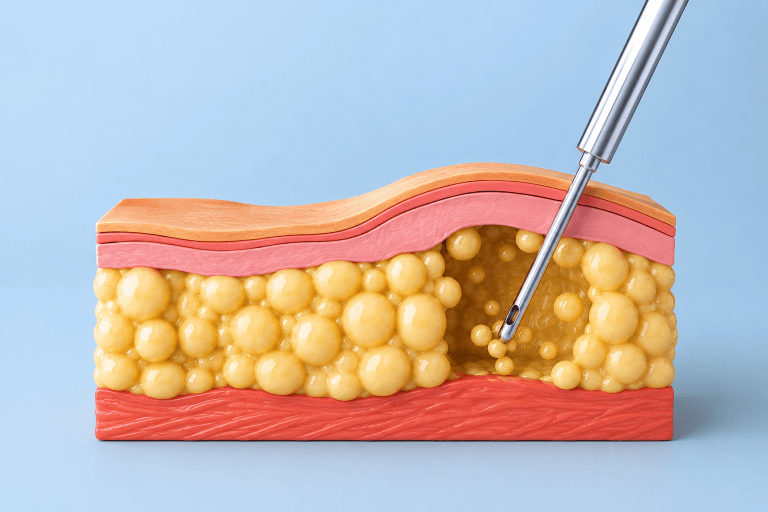
The abdomen. Men carry more of their fat inside the abdominal cavity, around the organs, rather than under the skin. After weight loss a man can have loose skin and still have a rounded abdomen, because the remaining fullness is visceral and no tummy tuck or liposuction reaches it. I measure this in the consultation. If the abdomen is still firm and rounded when the patient lies flat, the skin is not the main problem and further weight loss comes first. When the skin is the problem, the male tummy tuck is a different operation: the scar sits lower and flatter to hide under a waistband, the umbilicus is shaped and positioned for a male midline, and the goal is a straight, athletic contour, not a defined waist. Liposuction of the flanks almost always goes with it.
The chest. After weight loss the male chest is the most frequently disappointing area, because it combines three problems: residual fat, stretched glandular tissue, and loose skin with a nipple that has drifted downward. Liposuction alone works for the first. The second needs gland removal. The third needs a lift, which means a scar around the areola or, in severe cases, along the chest fold. Men often want the third result with the first operation’s scar. That conversation has to happen before surgery, not after.
The face. A man’s facial skin is thicker and much more vascular because of the beard, and the numbers reflect it. The classic paper on male facelifts, from 1977, reported large haematomas more than twice as often in men as in women. A 2017 series of 83 men matched against 83 women found bleeding under the skin in 6% of the men and none of the women. A 2024 review of 45 studies lists male sex as an established risk factor alongside high blood pressure and blood thinners. That changes how I manage blood pressure before, during and after surgery. The incision also has to respect the beard line and the sideburn. Pull bearded skin behind the ear and the patient shaves in a place no man shaves; that is the signature of a badly planned male facelift. Most men wear short hair, so the scar cannot hide in it. The approach has to be planned so the scar sits inside natural creases and the hairline stays where it was. The typical male complaint after weight loss is the neck, not the cheek, and the deep plane technique addresses both without over-tightening the skin.
The rest of the body. Arms, thighs and the lower back matter to men who lost 30 kg or more, and the honest news is that these scars are long and visible. Some men accept the loose skin once they understand the trade; others want the scar and the shape. Both are legitimate. My job is to show you exactly where the scar will sit and what it will look like at a year, and then the decision is yours.
The practical takeaway for patients
Three rules. First, your weight should be stable for four to six months before any of this, and if you are on a weight-loss medication, your surgeon needs to know: you usually keep taking it, and we change the fasting instead (clear liquids only for the 24 hours before surgery). Second, there is no fixed order of operations. The plan follows your priority, not a checklist. For many men the answer is liposuction alone, and since they are already in theatre, the chest is corrected in the same session. When the weight loss has been large, liposuction is no longer enough and we move to skin removal. Which area comes first is decided with you, in the consultation, based on what bothers you most. Third, ask your surgeon to show you male results specifically, at six months or later, not four weeks. If the surgeon’s gallery is all women, that tells you something.
Honest limits
Men who have carried significant weight often arrive with sleep apnoea, high blood pressure or a heart that has worked harder than it should for years. Some of those conditions improve with weight loss and some do not, and the surgeon has to test rather than assume. Muscle loss during rapid weight loss is real, and I will not pretend that most men arrive with a training routine. What I ask for is simpler: enough protein in the weeks before surgery, no further dieting in the last month, and daily walking. Exercise helps everyone, but it is not a condition of surgery.
I also cannot promise that nobody will notice. The men in the news story wanted to look like themselves, only lighter, and that is achievable for the face and the abdomen. It is harder for the chest and arms, where the choice is loose skin or a scar. There is no third option.
If you have lost a significant amount of weight and want to know which of these applies to you, send two photos and your weight history to +90 544 772 0772.
Dr. Mustafa Aydınol is a plastic, reconstructive and aesthetic surgeon in Istanbul and a member of ISAPS.
Sources
- Baker DC, Aston SJ, Guy CL, Rees TD. The male rhytidectomy. Plast Reconstr Surg, 1977. DOI
- Rohrich RJ et al. The modern male rhytidectomy: lessons learned. 83 men and 83 age-matched women. Plast Reconstr Surg, 2017. DOI
- Stewart CM, Bassiri-Tehrani B, Jones HE, Nahai F. Evidence of hematoma prevention after facelift. Review of 45 studies. Aesthet Surg J, 2024. DOI